
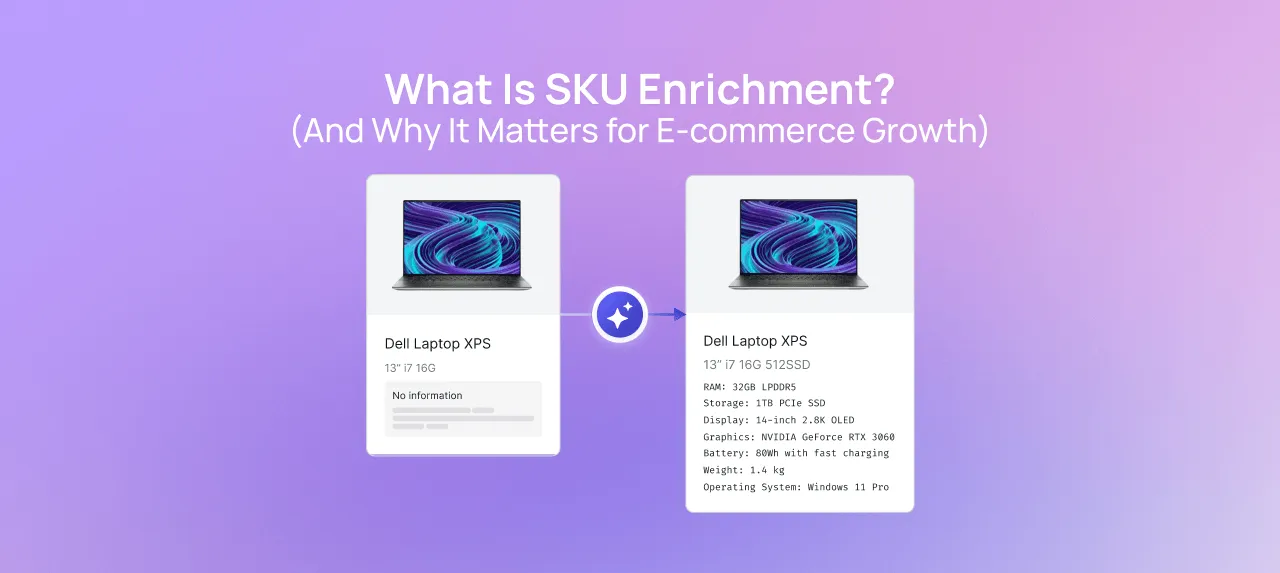
What Is SKU Enrichment? (And Why It Matters for E-commerce Growth)

SKU enrichment improves raw product data by adding, structuring, and optimizing the information tied to each SKU so it is complete, accurate, and ready for e-commerce.

This feature is available for customers on the

Tier or higher. Reach out to book a demo with our sales team today.

This feature is available for customers on the

Tier. Reach out to book a demo with our sales team today.

What Is SKU Enrichment? (And Why It Matters for E-commerce Growth)

On this page

SKU enrichment is the process of improving raw product data by adding, structuring, and optimizing the information tied to each SKU so it is complete, accurate, and ready for e-commerce.

In simple terms, it’s the difference between the state supplier product data is received and what customers actually need to make a decision.

Most supplier data is incomplete, inconsistent, or generic. SKU enrichment fills in those gaps so products can be discovered, understood, and purchased with confidence.

What Does SKU Enrichment Actually Mean in Practice?

At a practical level, SKU enrichment is not just “adding more data.”

It’s about making product data usable across systems and meaningful to customers.

That includes:

  • Structuring attributes so filters and search work properly
  • Writing clear, benefit-led descriptions
  • Standardizing formats across thousands of SKUs
  • Adding missing fields like materials, dimensions, compatibility, or use cases
  • Optimizing content for search and AI-driven discovery

For most e-commerce teams, this work sits between supplier ingestion and publishing products live on websites and marketplaces.

Without enrichment, products may technically be “live,” but they are unlikely performing to their full potential.

SKU Enrichment vs Product Content Enrichment

These terms are often used interchangeably, but they are not exactly the same.

Here’s how to think about the difference:

Category SKU Enrichment Product Content Enrichment
Scope SKU-level (variant-specific) Product-level (shared content)
Focus Attributes, specs, structured data Descriptions, messaging, storytelling
Example Size, weight, compatibility, materials Product overview, benefits, use cases
Impact Search filters, discovery, accuracy Conversion, engagement, brand clarity

High-performing e-commerce teams need both.

SKU enrichment ensures products can be found and filtered correctly, while content enrichment ensures they can be understood and confidently purchased.

Why SKU Enrichment Matters

SKU enrichment is often treated as a backend task despite the fact that it directly impacts revenue. That means retailers who understand the nuance can pull ahead in terms of performance and market capture when SKU enrichment is treated as a priority. This perspective comes with many compounding benefits.

Better Search and Discovery

Search engines, site search tools, and filters rely on structured attributes. If key fields are missing or inconsistent:

  • products don’t appear in results
  • filters break or return incomplete sets
  • customers can’t narrow down options

Clean SKU data ensures products show up when and where they should.

Higher Conversion Rates

Customers don’t buy what they are not confident. When product pages lack:

  • clear specs
  • relevant details
  • structured comparisons

potential buyers hesitate or flat out leave.

Enriched SKUs remove friction and make it easier to answer the question, “Is this the right product for me?”

Reduced Returns

Returns often come from mismatched expectations. Incomplete or vague product data leads to:

  • wrong sizes
  • incorrect compatibility
  • missing use-case clarity

SKU enrichment helps set accurate expectations before purchase.

Faster Time to Market

Manual enrichment slows everything down. Teams often get stuck spending:

  • days reviewing supplier data
  • weeks filling gaps
  • months clearing SKU backlogs

A structured enrichment approach allows products to go live faster without sacrificing quality.

Foundation for AI and Modern Discovery

AI-driven search, recommendations, and agents rely on structured, complete data. If your catalog is inconsistent:

  • AI cannot interpret product attributes correctly
  • recommendations become unreliable
  • conversational search breaks down

SKU enrichment is what makes product data usable by machines, not just humans.

What Data Gets Enriched?

SKU enrichment touches every layer of product data.

Data Category What It Includes Examples Why It Matters
Core Attributes Essential product details that define the SKU Size, dimensions, weight, material, color, variants Enables accurate filtering, comparison, and product selection
Functional Details Technical and performance-related specifications Battery life, power output, compatibility, certifications Helps customers evaluate suitability and reduces purchase uncertainty
Commercial Information Data tied to selling and fulfillment Pricing tiers, packaging details, availability, shipping info Supports purchasing decisions and operational accuracy
Content and Context Descriptive and contextual product information Product descriptions, use cases, FAQs, comparisons Drives conversion, improves SEO, and enhances product understanding

The goal is not just completeness, but consistency and structure across the entire catalog.

The SKU Enrichment Process

While every business is different, most enrichment workflows follow a similar structure.

a diagram showing the SKU enrichment process from start to finish, including data ingestion, standardization, gap identification, enrichment, validation, and publishing trustanar

1. Data Ingestion

Supplier data is imported from spreadsheets, APIs, or catalogs.

2. Standardization

Fields are mapped into a consistent schema so products follow the same structure.

3. Gap Identification

Missing or incomplete attributes are identified across SKUs.

4. Enrichment

Data is added or generated:

  • attributes are filled in
  • descriptions are improved
  • formats are normalized

5. Validation

Rules are applied to ensure accuracy and consistency.

6. Publishing

Enriched SKUs are pushed to e-commerce platforms, marketplaces, or feeds.

Before vs After: What SKU Enrichment Changes

a side by side comparison of the same product with a standard product profile, and an enriched product profile trustana

Before Enrichment

  • Title: “Wireless Headphones Model X”
  • Description: “High quality sound”
  • Attributes: Missing battery life, connectivity, compatibility

After Enrichment

  • Title: “Wireless Bluetooth Headphones with 30-Hour Battery Life”
  • Description: Clear benefits, use cases, and features
  • Attributes:
    • Battery life: 30 hours
    • Connectivity: Bluetooth 5.0
    • Compatibility: iOS, Android, PC
    • Weight: 250g

The difference is not subtle.

One version creates uncertainty. The other enables confident purchase decisions.

Common SKU Enrichment Challenges

When it comes to SKU Enrichment challenges, most teams struggle with the same issues.

ovde isto 
Challenge What It Looks Like Impact on Ecommerce Performance
Inconsistent Supplier Data Different formats, naming conventions, and missing fields across suppliers Breaks filtering and search, creates confusion, and slows onboarding
Manual Workflows Teams rely on spreadsheets and manual edits to fill in product data Limits scale, increases time to market, and introduces human error
Lack of Standardization No consistent schema for attributes across categories or products Leads to inconsistent product pages and poor customer experience
Resource Constraints Merchandising or ecommerce teams lack time or bandwidth to enrich SKUs Creates SKU backlogs and delays revenue from products not yet live
Generic Manufacturer Content Product descriptions are copied directly from suppliers Hurts SEO, reduces differentiation, and weakens conversion rates

Next Steps with SKU Enrichment

SKU enrichment is not just about improving product data.

It’s about turning a catalog into something that can:

  • be discovered
  • be understood
  • and ultimately convert

As e-commerce continues to shift toward AI-driven discovery and decision-making, the quality of your SKU data becomes a direct driver of performance.

Teams that treat product data as infrastructure move faster, scale more efficiently, and compete more effectively.

Want to see how Trustana automates SKU Enrichment to reduce SKU launch time by 99%? Book a Demo with the product data experts today.
SKU Enrichment FAQ

What is the difference between SKU enrichment and data cleansing?

Data cleansing focuses on fixing errors. SKU enrichment goes further by adding missing information and improving usability.

When should a business invest in SKU enrichment?

If you have a SKU backlog, poor search performance, or inconsistent product pages, it’s time to invest.

Do I need to replace my PIM to support SKU enrichment?

No. Most teams benefit from adding an enrichment layer that works alongside existing systems rather than replacing them.

How does SKU enrichment impact SEO?

Structured, complete product data improves indexability, relevance, and long-tail keyword coverage, leading to better rankings.

Can SKU enrichment be automated?

Yes. Modern approaches use AI and rules-based systems to scale enrichment across large catalogs while maintaining consistency.

How does SKU enrichment support AI-driven commerce?

AI systems rely on structured attributes to interpret products. Without enrichment, AI cannot accurately recommend, compare, or surface products.

What types of products benefit most from SKU enrichment?

Products with complex specifications, multiple variants, or technical attributes see the greatest impact.

Get an Expert Review of Your Product Data

Get practical guidance on improving catalog quality, enrichment workflows, and AI readiness based on your current setup.

SKU Enrichment
sku-enrichment
AI PIM (AI-Powered Product Information Management)
ai-pim-ai-powered-product-information-management
Enrichment Layer
enrichment-layer
Large Language Model (LLM)
large-language-model-llm
Dynamic Synthesis
dynamic-synthesis
Operational Layer
operational-layer
Evidence Layer
evidence-layer
Probabilistic Accuracy
probabilistic-accuracy
Deterministic accuracy
deterministic-accuracy
Product Attribute
product-attribute
Intelligent Product Attribute
intelligent-product-attribute
Factual Product Attribute
factual-product-attribute
Structured Product Attribute
structured-product-attribute
Google MCP (Model Context Protocol)
google-mcp-model-context-protocol
Retrieval-Augmented Generation (RAG)
retrieval-augmented-generation-rag
Product Data Activation (PDA)
product-data-activation-pda
Product Data Architecture (PDA)
product-data-architecture-pda
Context Graph
context-graph
Buy to Detail Rate (BTD)
buy-to-detail-rate-btd
White Label Product
white-label-product
User Experience (UX)
user-experience-ux
UPC (Universal Product Code)
upc-universal-product-code
Third-Party Marketplace
third-party-marketplace
Syndication
syndication
Structured Data
structured-data
Sell-Through Rate
sell-through-rate
Stale Content
stale-content
Search Relevance
search-relevance
Search Merchandising
search-merchandising
SKU-Level Analytics
sku-level-analytics
SKU Rationalization
sku-rationalization
SKU Performance
sku-performance
SKU (Stock Keeping Unit)
sku-stock-keeping-unit
SEO (Search Engine Optimization)
seo-search-engine-optimization
Rich Media
rich-media
Retailer Portal
retailer-portal
Retail Media
retail-media
Retail Content Syndication
retail-content-syndication
Repricing Tool
repricing-tool
Retail Analytics
retail-analytics
Replatforming
replatforming
Real-Time Updates
real-time-updates
Quality Assurance (QA)
quality-assurance-qa
Product Visibility
product-visibility
Product Variant
product-variant
Product Validation
product-validation
Product Upload
product-upload
Product Title Optimization
product-title-optimization
Product Taxonomy Tree
product-taxonomy-tree
Product Taxonomy
product-taxonomy
Product Tagging
product-tagging
Product Syndication Lag
product-syndication-lag
Product Syndication
product-syndication
Product Schema
product-schema
Product Status Tracking
product-status-tracking
Product Page Bounce Rate
product-page-bounce-rate
Product Onboarding
product-onboarding
Product Metadata
product-metadata
Product Matching
product-matching
Product Lifecycle Stage
product-lifecycle-stage
Product Information Management (PIM)
product-information-management-pim
Product Lifecycle Management (PLM)
product-lifecycle-management-plm
Product Info Templates
product-info-templates
Product Import
product-import
Product Feed Validation
product-feed-validation
Product Feed Scheduling
product-feed-scheduling
Product Feed
product-feed
Product Family
product-family
Product Discovery
product-discovery
Product Export
product-export
Product Dimension Attributes
product-dimension-attributes
Product Detail Page (PDP)
product-detail-page-pdp
Product Description
product-description
Product Data Versioning
product-data-versioning
Product Data Syndication Platforms
product-data-syndication-platforms
Product Data Sheet
product-data-sheet
Product Data Quality
product-data-quality
Product Content Management (PCM)
product-content-management-pcm
Product Data Harmonization
product-data-harmonization
Product Content Enrichment
product-content-enrichment
Product Comparison
product-comparison
Product Compliance
product-compliance
Product Channel Fit
product-channel-fit
Product Categorization
product-categorization
Product Bundling
product-bundling
Product Badging
product-badging
Product Attributes
product-attributes
Product Attribute Completeness
product-attribute-completeness
Price Scraping
price-scraping
Personalization
personalization
PDP Optimization
pdp-optimization
PDP Heatmap
pdp-heatmap
PDP Conversion Rate
pdp-conversion-rate
Out-of-Stock Alerts
out-of-stock-alerts
Omnichannel
omnichannel
Omnichannel Strategy
omnichannel-strategy
Net New SKU Creation
net-new-sku-creation
Multichannel Retailing
multichannel-retailing
Metadata
metadata
Mobile Optimization
mobile-optimization
Merchant-to-Merchant (M2M)
merchant-to-merchant-m2m
Marketplace Listing Errors
marketplace-listing-errors
Marketplace Reconciliation
marketplace-reconciliation
Marketplace Compliance
marketplace-compliance
Marketplace
marketplace
MAP Pricing (Minimum Advertised Price)
map-pricing-minimum-advertised-price
Localization Tags
localization-tags
Long-Tail Keywords
long-tail-keywords
Listing Optimization
listing-optimization
Lifecycle Automation
lifecycle-automation
Key Performance Indicator (KPI)
key-performance-indicator-kpi
Inventory Management
inventory-management
Intelligent Search
intelligent-search
Image Optimization
image-optimization
Hyperpersonalization
hyperpersonalization
Headless Commerce
headless-commerce
Generative Engine Optimization (GEO)
generative-engine-optimization-geo
Generative AI
generative-ai
Fuzzy Search
fuzzy-search
GTM (Go-to-Market) Strategy
gtm-go-to-market-strategy
GTIN (Global Trade Item Number)
gtin-global-trade-item-number
Flat File
flat-file
First-Party Data
first-party-data-a51e9
First-Party Data
first-party-data
First-Mile Fulfillment
first-mile-fulfillment
Feed Testing Environment
feed-testing-environment
Feed-Based Advertising
feed-based-advertising
Feed Optimization Tool
feed-optimization-tool
Feed Management
feed-management
Feed Diagnostics
feed-diagnostics
Faceted Search
faceted-search
ERP (Enterprise Resource Planning)
erp-enterprise-resource-planning
Explainable AI
explainable-ai
Enrichment Rules
enrichment-rules
Enhanced Brand Content (EBC)
enhanced-brand-content-ebc
EPID (eBay Product ID)
epid-ebay-product-id
EAN (European Article Number)
ean-european-article-number
E-commerce Platform
e-commerce-platform
Dynamic Pricing
dynamic-pricing
Duplicate Content
duplicate-content
Direct-to-Consumer (DTC)
direct-to-consumer-dtc
Drop Shipping
drop-shipping
Digital Transformation
digital-transformation
Digital Shelf
digital-shelf
Digital Asset Management (DAM)
digital-asset-management-dam
Data Syncing
data-syncing
Data Normalization
data-normalization
Data Mapping
data-mapping
Data Governance
data-governance
Data Feed Transformation
data-feed-transformation
Data Feed Rules
data-feed-rules
Data Feed Error Report
data-feed-error-report
Data Enrichment Pipeline
data-enrichment-pipeline
Data Drift
data-drift
Data Deduplication
data-deduplication
Data Clean-up
data-clean-up
Customer Experience (CX)
customer-experience-cx
Conversion Rate
conversion-rate
Content Scalability
content-scalability
Content Localization
content-localization
Content Governance
content-governance
Content Gaps
content-gaps
Consumer-to-Merchant (C2M)
consumer-to-merchant-c2m
Channel-Specific Optimization
channel-specific-optimization
Channel Readiness
channel-readiness
Category Mapping
category-mapping
Catalog Management
catalog-management
Buy Now, Pay Later (BNPL)
buy-now-pay-later-bnpl
Breadcrumb Navigation
breadcrumb-navigation
Automated Categorization
automated-categorization
Automated Content Generation
automated-content-generation
Automated Workflows
automated-workflows
Blacklisting (in feeds)
blacklisting-in-feeds
Attribution Tags
attribution-tags
Attribute Standardization
attribute-standardization
Answer Engine Optimization (AEO)
answer-engine-optimization-aeo
Artificial Intelligence (AI)
artificial-intelligence-ai
Attribute Mapping
attribute-mapping
Agentic E-commerce
agentic-e-commerce
A/B Testing
a-b-testing
API (Application Programming Interface)
api-application-programming-interface
AI Overviews
ai-overviews
AI Tagging
ai-tagging
AI Agents
ai-agents
AI Indexing
ai-indexing