
.webp)
Anyone working in e-commerce operations knows supplier product data rarely arrive clean and complete.
It all begins when their spreadsheet or PDF arrives and you brace yourself for what you'll find inside. Sometimes it is clean, though most of the time it isn't.
Columns may be missing. Product names are inconsistent. Units of measure are mixed. Images arrive in a separate folder with file names that do not match the SKUs in the sheet. Descriptions are short or copied from a catalog meaning they need to be rewritten to be uniqiue among other vendors. Technical attributes may not exist at all. The list goes on.
Then, the work begins. Files get imported, rows get cleaned, products get uploaded, and the team move on. But, it doesn't stop there.
Give it a little time and, as your catalog grows, it becomes a compounding task to add to the catalog and apply the updates suppliers send. Product variations begin multiplying and what took a few minutes per import now demands hours every week to fix before products can ever be sold.
This is why supplier product data management is a step in the process that can't be ignored. It compounds like debt you get further behind in paying with every new cycle.
Fortunately, when supplier product data is structured properly, product onboarding becomes a predictable and scalable process with less and less friction as time goes on.
Here's how we break down the concept of managing supplier product data, starting with the issues it causes, how it impacts businesses all over the world across industries, and what it takes to turn supplier data into a benefit, rather than a burden.
What Is Supplier Product Data Management?
Let's define it, so we're all on the same page.
Supplier product data management is the process of collecting, standardizing, validating, enriching, and publishing product data received from vendors.
The goal is simple: transform inconsistent supplier input into structured product data that works across e-commerce and other retail business systems, like PIM and ERP.
This process typically follows four stages:
When this workflow is structured, product onboarding becomes easier for everyone.
When it isn't, every supplier upload becomes a manual cleanup exercise and all things downstream suffer from the resulting inefficiency.
Why Supplier Product Data Is Almost Always Inconsistent
Suppliers rarely structure product data for e-commerce retailers because they structure it for their own internal systems, then send it to their customers: retailers.
This difference in priorities creates inconsistencies.
Color attributes may appear as:
- Color
- Colour
- Shade
- Included in the product title
Dimensions may appear in multiple formats:
- 10 cm
- 100mm
- 10 centimeters
- 10 x 20 x 5
Selling products are in multiple regions? This lack of standardization adds another layer of cleanup.
Don't forget about file naming conventions. Images often arrive in folders labeled:
- product_image_final.jpg
- image_new_v2.png
- IMG_48392.jpg
When none of these filenames match SKUs, a person has to manually determine which image belongs to which product.
Multiply this problem across dozens of suppliers and thousands of SKUs, and supplier data quickly becomes one of the largest operational challenges in e-commerce.
When the data arrives, retailers have to make a decision:
- Do nothing (the bad one)
- Enrich the supplier data manually (a ugly one)
- Automated product content enrichment (the good one)
If you want a comprehensive breakdown of how enrichment improves product listings and catalog quality, see this guide on product content enrichment.
The Hidden Cost of Poor Supplier Product Data Management
We've covered the obvious issues supplier product data inconsistency can cause teams. Let's explore how the impact spreads in less obvious ways.
When all is said and done, the most expensive cost is time.
If onboarding 1,000 products takes weeks instead of days, catalog growth slows dramatically and new products can't get to market fast enough. They miss seasonal deadlines or miss wave of interest, costing potential sales.
This is why many retailers begin investing in product data architecture early on, and continue to do so as their catalogs scale.
A strong architecture defines how product information flows through systems and ensures every attribute follows the same rules. You can explore that concept further in this guide.
Common Supplier Product Data Formats Retailers Receive
Retailers typically receive supplier product data in several formats.
Because these formats are inconsistent, retailers are forced to spend hours restructure supplier data before publishing products online.
Many retailers also receive product information embedded inside supplier catalogs and PDFs. Extracting structured attributes from those documents has historically been a manual process. However, modern AI tools can now automate this process for retailers as part of their enrichment workflow.
Supplier Product Data Management vs PIM Systems
Supplier product data management is often confused with Product Information Management (PIM).
They serve different roles.
Many retailers run supplier data through enrichment workflows before it ever enters their PIM or e-commerce platform. It's a good step to take because it avoids manual cleanup and rework later.
For example, AI-driven product data enrichment systems can automatically generate structured attributes, product descriptions, and SEO-ready content from incomplete supplier data.
How E-commerce Teams Standardize Supplier Product Data
Effective supplier product data management starts with a clear internal product data model. It's going to vary from one industry to another. The important part is to ensure coverage, so data gaps are closed, and completeness to ensure your customers and teams can easily find what they are looking for relative to a product catalog.
Retailers typically standardize their definitions across:
- product attributes
- measurement units
- category taxonomies
- required fields for internal onboarding & marketplaces
Supplier product data is then mapped using that governing structure across the organization's data systems.
For example:
These mapping rules allow product data from multiple suppliers to follow the same structure, while at the same time reducing confusion among shoppers evaluating products as part of the buying process.
Normalization vs Enrichment
Supplier product data management includes two related but distinct processes.
The first is product data normalization, or product data unification, and it ensures supplier data is clean and consistent. Examples include:
- converting measurement units
- standardizing attribute names
- validating required fields
Product data enrichment improves the depth and quality of product content. This can include:
- adding structured attributes
- expanding product specifications
- improving product descriptions
- preparing product data for search and recommendation systems
Both processes are required for a high-performing e-commerce catalog.
If you want to see how enrichment directly impacts conversion and search visibility, this article explains the hidden costs of poor product content.
How Automation Scales Supplier Product Data Management
Manual supplier data cleanup simply does not scale. To keep up with the process as the business and catalog grow, so too must headcount.
Automation allows retailers to manage large product catalogs without expanding operational headcount.
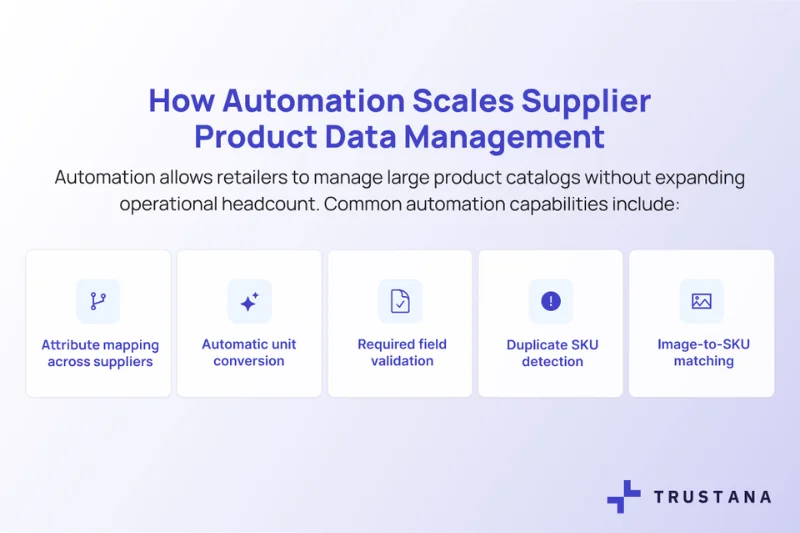
Common automation capabilities include:
- attribute mapping across suppliers
- automatic unit conversion
- required field validation
- duplicate SKU detection
- image-to-SKU matching
More advanced systems can also enrich product data from PDFs or generate product attributes from unstructured descriptions.
Automation facilitates the shift from manual editing to structured review.
Why Structured Product Data Matters for AI and E-commerce
The utility of product data has moved well beyond product detail pages (PDPs).
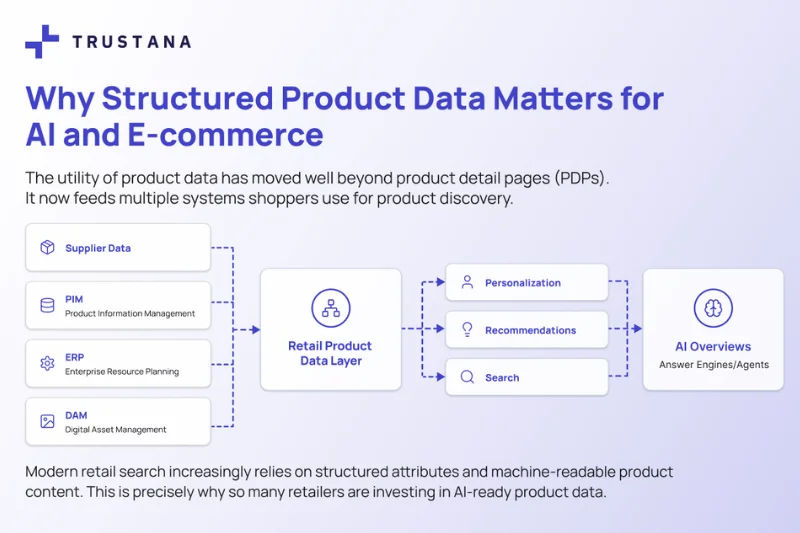
It now feeds multiple systems shoppers use for product discovery, such as:
- e-commerce search engines
- product recommendation engines
- marketplace algorithms
- AI-powered shopping assistants
Modern retail search increasingly relies on structured attributes and machine-readable product content. This is precisely why so many retailers are investing in AI-ready product data.
Retailers who ignore the writing on the wall and delay investing in structured product data risk lower search visibility, weaker product discovery, and missed revenue opportunities.
Preparing Supplier Product Data for AI-Driven Commerce
Retail discovery is rapidly shifting toward AI-driven search and recommendation systems. Think ChatGPT, Perplexity, Claude, AI Overviews, and the like.

In emerging models, such as agentic commerce, intelligent agents evaluate product data automatically when helping customers discover products. For these environments, structured product attributes matter far more than marketing copy.
Machines prioritize clear, standardized data to make accurate recommendations. As a result, retailers with structured supplier product data will inherently have a major advantage in AI-driven discovery.
Treat Supplier Product Data as E-commerce Infrastructure
The highest performing e-commerce companies treat managing supplier product data differently than those who see it as a clerical task. For them, it's essential infrastructure and it's a critical component of operations.
They're ready before the data even lands in their inbox. They define product taxonomies early, standardize supplier inputs, and build repeatable workflows that convert supplier spreadsheets into structured product assets so it can be utilized immediately.
Once this foundation exists, supplier product data management stops being a daily operational problem and becomes a growth advantage.
Manage supplier data more easily with Trustana. To see how we do it live, speak with an expert to set up a personalized demo today.