
Legacy PIM to AI PIM: The Evolution of Product Information Management

The evolution of PIM to AI PIM is the story of how product data has turned into fuel for digital commerce and AI-driven decision-making.

This feature is available for customers on the

Tier or higher. Reach out to book a demo with our sales team today.

This feature is available for customers on the

Tier. Reach out to book a demo with our sales team today.

Legacy PIM to AI PIM: The Evolution of Product Information Management

On this page

The evolution of PIM is really the story of how product data has turned from a tool reserved for internal operations into fuel for digital commerce and AI-driven decision-making.

The Evolution of Legacy PIM to AI PIM

Before we dive into the differences and advancements an AI PIM offers, we need to acknowledge that what's missing from that ultra-distilled "what" is the whyit happened in the first place.

So, let’s walk through it.

The Original Role of PIM: Internal Control

When PIM systems first emerged in the early 2000s, their job was simple: Keep product data organized across internal systems. Perspectives revolved around operational functions and the mindset of "make usre our data is correct and consistent."

At the time, e-commerce was limited, there were far fewer channels to navigate, and product data was mostly static.

So, PIM was designed to do meet the moment in terms of:

  • Consolidating product data from ERP systems
  • Standardizing fields like SKU, price, dimensions
  • Ensuring consistency across catalogs and print materials

E-commerce Expansion: Managing Complexity

As e-commerce scaled, the role of PIM expanded alongside the need for product data to support websites, marketplaces, mobile experiences, and regionally specific catalogs.
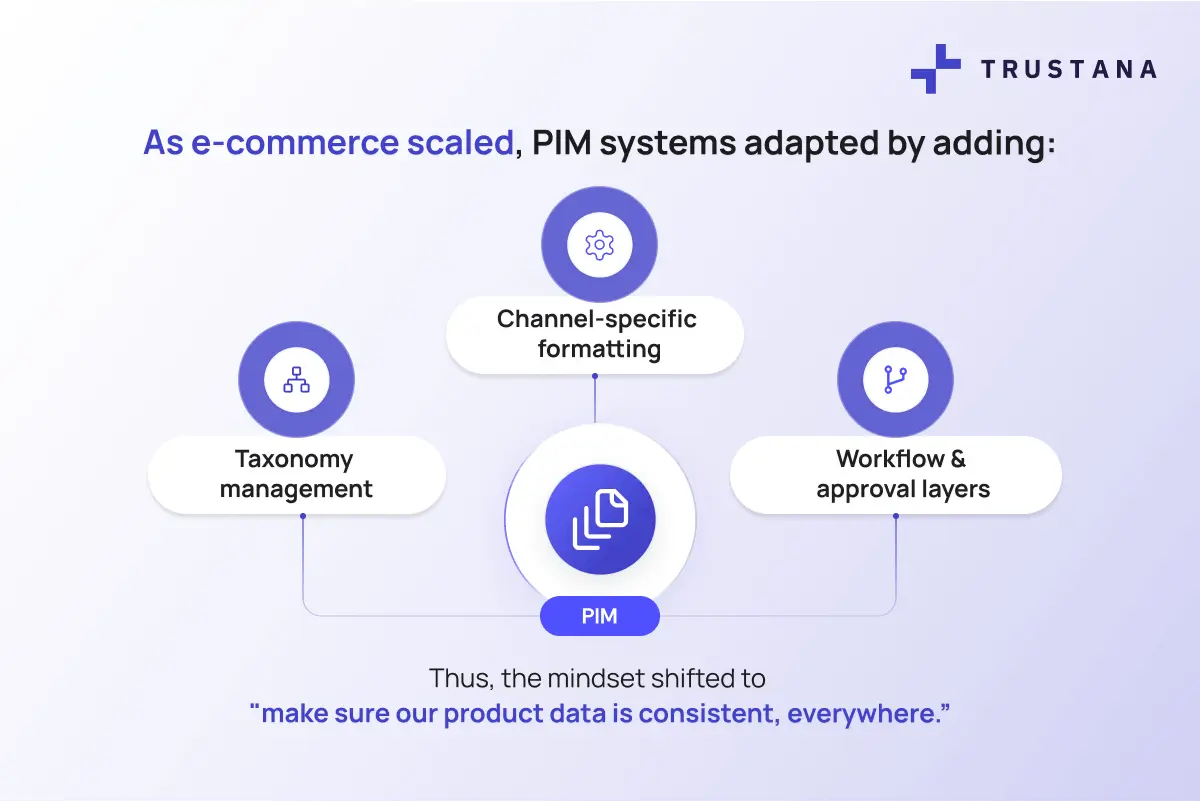
an image depicting how PIM systems adapted to e-commerce proliferation trustana

With more SKUs, more channels, and more variations in how product data needed to appear, PIM systems adapted by adding:

  • Taxonomy management
  • Channel-specific formatting
  • Workflow and approval layers

Thus, the mindset shifted to "make sure our product data is consistent, everywhere."

The Breaking Point: Product Dhata Volume + Fragmentation

Product data was relatively easy to manage with a few thousand SKUs but as catalogs scaled into the tens or hundreds of thousands, a new problem emerged: the data itself wasn't good enough.

Teams quickly became mired in incomplete supplier data, inconsistent attributes across sources, generic or duplicate descriptions, and massive manual workloads. As a result, the PIM systems themselves became bottlenecks.

They lost their edge as systems of control because they were asked to do things they were never designed to do, like:

  • Create missing data
  • Interpret unstructured inputs
  • Scale content production

This shifted the thinking for retail and e-commerce teams once more into, "managing the data isn't enough. We need to fix it."

The AI Inflection Point: Product Data Becomes Fuel

E-commerce hit an inflection point with massive catalogs, seemingly endless streams of product data, and the proliferation of marketplaces, like Amazon, Wayfair, and Walmart, requiring strict yet disparate product listing criteria and conformity standards. It made retailers' jobs that much harder to get products onboarded, listed across channels, and in front of shoppers online.

AI stepped onto the scene and introduced incredible tools for discovery in the form of AI search, answer and recommendation engines, and conversational commerce.

The catch was everything hinged on product data for these tools to work. This exposed a critical gap for retailers who thought their PIM systems could address the needs of AI. Most PIM-managed data simply wasn’t usable by AI systems because it didn't have:

  • Complete attribute coverage
  • Structured, consistent data
  • Rich contextual content
  • machine-readable formats

The Rise of AI-Native PIM: From Storage to Transformation

This is where the concept of an AI-native PIM emerges.

The way retailers think about product data has shifted from, “How do we manage product data?” to, “How do we continuously improve product data so advanced systems, like LLMs and AI agents, can use it?”

The change was a structural one, where product information evolved from a static element of the business to a dynamic one.

While that product data was initially approached as a “set and forget” asset, the technology modern commerce utilizes demands product data be capable of adapting with consumer trends dynamically.

As part of that shift, dealing with huge amounts of product data can no longer be handled manually. Automation has to come into play. That's where product data enrichment leaves the hands of humans and enters PIM systems built with AI from the ground up, rather than an add-on to an existing platform.

Category Legacy PIM AI-Native PIM
Core Purpose Centralizes and governs product data as a system of record. Continuously improves and enriches product data as a system of intelligence.
Foundational Assumption Product data is provided and needs to be organized and controlled. Product data is incomplete by default and must be continuously improved.
Primary Role Stores, structures, and distributes product data. Builds, enriches, and optimizes product data before and alongside distribution.
Strengths Data standardization
Taxonomy management
Channel distribution
Approval workflows
Attribute creation and completion
Data enrichment from incomplete inputs
Continuous content optimization
Scalable automation of product data improvements
Handling of Incomplete Data Relies on teams to manually fill gaps and improve data quality. Actively fills missing attributes and enhances incomplete product records automatically.
Content Creation Typically manual or outsourced. AI-assisted and scalable content generation.
Data Evolution Static; updates occur manually and intermittently. Dynamic; data is continuously refined and improved over time.
Consistency vs Completeness Ensures consistency and control across the catalog. Ensures both consistency and completeness through enrichment.
Discoverability Limited by the quality and depth of existing data. Improves discoverability by expanding attributes and enriching content for search and filters.
AI Readiness Data may be structured but often lacks the depth and completeness required for AI systems. Prepares product data to be fully usable by AI systems, search engines, and recommendation models.
Overall Function System of record focused on control and governance. System of intelligence focused on improvement, enrichment, and performance.

The Missing Layer: AI Enrichment Changes Everything

Most teams don’t realize the core issue isn’t their PIM. It's the fact that it lacks a critical element, one that is necessary to enable and support AI operations interacting with product data.

The Experience:

A PIM can store this data but it cannot improve its quality, fill in the missing elements, or fix erroneous information at scale.

What is AI Enrichment?

This is where the enrichment layer comes in.

“Enrichment” can mean very different things depending on who you ask.

In many cases, it refers to a manual service. Teams or external agencies review product data, fill in missing attributes, rewrite descriptions, and standardize fields by hand. This approach can improve quality, but it’s time-intensive, difficult to scale, and often inconsistent across large catalogs. Factor in the cost associated with this approach and it's hardly an idealscenario.

AI-driven product content enrichment is fundamentally different.

Instead of relying on people to fix data one product at a time, it uses systems to process, structure, and improve product data at scale. This includes extracting attributes from unstructured sources like PDFs or images, standardizing values automatically, and generating content in a consistent format.

The difference becomes clear when you look at how the work gets done:

  • Manual enrichment depends on human effort and scales with headcount
  • AI-driven enrichment uses automation to handle large volumes quickly and consistently

More importantly, AI enrichment is not a one-time activity. It’s an ongoing process that continuously improves product data as new inputs are added or requirements change.

That’s what separates traditional enrichment from an AI-first approach. One is a task. The other is a system.

How Enrichment Contributes to Better Product Data

Instead of just storing data, the enrichment layer actively improves it. This typically includes:

1. Completes missing product data

  • Fills attribute gaps
  • Standardizes values
  • Builds structured fields

2. Translates unstructured inputs into usable data

  • PDFs → structured specs
  • Images → extracted attributes
  • Supplier text → normalized descriptions

3. Creates differentiated product content

  • Unique descriptions
  • Channel-specific formatting
  • SEO and AI-ready language

4. Expands attribute depth for discovery

  • Adds filters and facets
  • Improves product discovery
  • Supports long-tail queries

5. Continuously improves data quality

  • Iterative enrichment cycles
  • Feedback-driven updates
  • Ongoing optimization
an image detailing how better product enrichment contributes to better product data trustana

When you add the enrichment layer to your workflow, your product data becomes something you can grow, refine, and optimize. It's the difference between a static catalog and a living data foundation.

Structural Comparison: Legacy PIM vs AI PIM + Enrichment Layer

Here’s the full picture, at both the catalog level and the foundational data level:

Capability Legacy PIM (Catalog Support) AI-Native PIM + Enrichment (Data Foundation)
Core Role Stores, organizes, and governs product data across the catalog. Builds, enriches, optimizes, and prepares product data for downstream AI, search, and commerce use cases.
Primary Function Acts as a system of record. Acts as a system of intelligence and continuous improvement.
Data Input Relies on supplier feeds, manual uploads, spreadsheets, and internal system imports. Ingests structured and unstructured data from supplier feeds, PDFs, images, APIs, websites, and internal files.
Data Completeness Depends heavily on the quality and completeness of source data provided. Actively identifies gaps and fills missing fields, attributes, and content at scale.
Attribute Coverage Supports fixed schemas and predefined attribute structures. Expands attribute depth dynamically based on category, search intent, and discovery needs.
Attribute Quality Requires manual cleanup and normalization by internal teams. Automates normalization, standardization, and enrichment of attribute values.
Handling Incomplete Supplier Data Stores incomplete data and depends on teams to manually patch gaps. Transforms incomplete supplier data into more complete, usable, structured product records.
Content Creation Usually handled manually, by merchants, copywriters, or external agencies. Uses AI-assisted generation to create and scale product titles, descriptions, and supporting content.
Product Descriptions Often generic, reused, or copied directly from manufacturer inputs. Can generate unique, contextual, channel-aware descriptions optimized for discovery and conversion.
Data Transformation Limited transformation capabilities, often rules-based and manual. Performs deeper transformation of raw, messy, or fragmented product inputs into usable structured data.
Taxonomy Support Supports category mapping and product classification. Supports taxonomy while also improving classification quality through enriched and standardized product signals.
Search Readiness Supports basic keyword-based catalog organization. Prepares product data for semantic search, natural language queries, AI search, and answer engines.
Filter and Facet Support Limited to whatever structured attributes already exist in the catalog. Improves filter coverage by expanding and standardizing structured attributes needed for faceted navigation.
AI Readiness Provides a stable storage layer, but usually lacks the richness and completeness AI systems need. Creates the structured, contextual, and complete product data foundation AI needs to perform well.
Channel Adaptation Distributes product data to channels once it has been prepared. Helps shape and optimize product data for different channels, formats, and downstream requirements.
Image Support Stores and associates images with product records. Can support image analysis, framing, optimization, tagging, and extraction of product signals from visual inputs.
Speed to Publish Depends on manual workflows, approvals, and resource availability. Accelerates time to publish through automation, faster enrichment, and reduced manual handling.
Catalog Scalability Scaling often requires more people, more agency support, or longer timelines. Scales enrichment and improvement across large catalogs without linear headcount growth.
Continuous Improvement Updates happen manually and often only when teams have time. Supports ongoing improvement loops that continuously refine product data quality and coverage.
Operational Burden Puts more pressure on internal teams to clean, write, map, and maintain product data manually. Reduces repetitive manual work so teams can focus more on review, governance, and strategy.
Differentiation Often leaves teams publishing the same supplier content as competitors. Enables differentiated, enriched content that helps products stand out in search and on PDPs.
Foundation for AI Outcomes Supports storage and governance, but does not fully prepare product data for AI-driven performance. Strengthens the foundational product data layer so AI tools, search systems, and discovery experiences can work effectively.
Role in the Commerce Stack Best suited as the governed source of truth for product records. Best suited as the enrichment and intelligence layer that strengthens product data before and alongside governance.

Static vs Dynamic: The Real Architectural Divide

We touched on this distinction earlier in the article but want to emphasize that this is not just a feature comparison.

There is a structural difference between the two approaches to product data. Here's a simplified comparison:

Legacy PIM = Static Model

  • Fixed schemas
  • Human-driven updates
  • One-time data preparation

AI PIM + Enrichment = Dynamic Model

  • Adaptive attributes
  • Continuous improvement
  • Feedback-driven data evolution

When all's said and done, modern commerce is dynamic, which means your data layer needs to be too.

Why Enrichment Matters for AI, Search, and Discovery

AI systems can't function properly when product data is incomplete.

Modern discovery, whether it’s search, filters, recommendations, or AI-generated answers, depends on depth and structure. It needs clearly defined attributes, consistent taxonomy, and enough context to understand what a product is, who it’s for, and when it should appear.

When that foundation is missing, products show up less often relative to competitors, they rank lower, or even get filtered out.

Over time, that leads to erosion of brand equity and how you are perceived by potential customers. It also undercuts all the hard work teams put in and results in a lackluster customer experience.

Some real world examples of this include:

  • Products failing to appear for long-tail or conversational queries
  • Filters returning incomplete or inconsistent results
  • Recommendation engines surfacing less relevant items
  • AI systems lacking the context to confidently promote or compare products

Teams may adopt new tools expecting better outcomes but those systems depend on the inputs they're given. And, without enriched product data, even the best AI struggles to deliver meaningful results. It's a significant risk to any retail AI investment.

As weak data continues to be used, the inconsistencies become more apparent and the gap widens between retailers who address it vs. those who do not.

For more information on how enable AI search and discovery, check out our guide to AI-ready product data.

When Should You Start Evaluating an AI PIM?

Most teams don’t wake up one day and decide to change how they manage product data. These systems are expansive, deeply engrained in how business gets done day-to-day, and take knwoeldge and training to operate correctly. A rip and replace approach is never the ideal scenario.

When products aren’t showing up where they should, search results are incomplete, and conversion rates plateau even when traffic grows, the impact moves closer to revenue. It's time to start looking at what's causing the problem.

Here are some indicators that an AI-first PIM may be worth evaluating.

When Data Becomes a Bottleneck

There’s a clear turning point in most organizations where product data stops being a background function and becomes a visible constraint.

It usually shows up in patterns like these:

  • Product onboarding cycles are slowing down, even as demand to launch faster increases
  • Teams are spending more time enriching data manually than driving merchandising or growth initiatives
  • Supplier data quality is inconsistent, requiring repeated cleanup across the same categories
  • Product content looks too similar to competitors, making it harder to differentiate
  • Investments in search, personalization, or AI are not producing meaningful improvements

Individually, these issues can be managed.

Together, they point to something structural.

The system is managing data, but not improving it.

When Growth Exposes Your Limits

Growth tends to amplify the problem.

What worked at 5,000 SKUs starts to break at 10,000. Just as what was manageable for one channel becomes increasingly complex as more are added.

Expansion often introduces new pressures in a variety of ways:

  • More categories, each with different attribute requirements
  • More suppliers, each with different data standards
  • More channels, each needing slightly different formats

At this stage, manual processes not only slow things down but they introduce inconsistency across the entire catalog that amplifies what's been wrong since the beginning. This inconsistency is exactly what modern discovery systems struggle with most.

When Data Needs to Do More Than Display

AI is the final trigger that tells a business it's time to start evaluating a solution to the problem. As soon as product data needs to support:

…the requirements change.

This goes beyond how data is arranged on a product page. This is how people are shopping now. They are using AI tools and answer engines to find the exact products for their job to be done. For your products to be seen and recommended, their foundational data needs to be:

  • Structured in a way machines can interpret
  • Complete enough to support filtering and comparison
  • Rich enough to answer questions without human intervention

This is where legacy systems fall short. They were simply built for a different purpose and time when these advanced technologies weren't part of the retail ecosystem.

A Simple Test

One of the simplest ways to evaluate your current state is to ask, “If we stopped manual enrichment tomorrow, would our catalog still perform?”

If the answer is no, then your system relies on people to maintain data quality.

That’s the clearest signal that it’s time to explore an AI PIM.

For more information on evaluating retail AI technologies, have a look at our Retail AI Evaluation Playbook.

So you're an AI PIM Expert, Now What?

All this to say, your legacy PIM systems are still essential. They provide structure, governance, and consistency across your catalog. However, they were never designed to carry the full weight of modern commerce.

They don’t create missing data.
They don’t enrich content at scale.
They don’t prepare product data for AI-driven discovery.

That responsibility sits squarely on the shoulders of the enrichment layer.

When these systems work together, the result is a stronger foundation. Not just a catalog that is organized, but one that is complete, structured, and continuously improving.

Fortunately, most retailers don’t need to replace their PIM to move forward in a world with AI. They need to strengthen what sits around it.

An AI-first enrichment layer can plug into your existing stack, improve product data at the source, and unlock better performance across search, discovery, and conversion without disrupting your current systems.

That’s where Trustana comes in. If you’re starting to see the signs in your own catalog, it may be worth taking a closer look. You can explore how it works with a free demo whenever you’re ready.
Legacy PIM vs AI PIM FAQ

What is the enrichment layer in a product data stack?

It’s the layer responsible for transforming raw product inputs into complete, structured, and optimized data before it enters the PIM.

Can AI PIM replace enrichment tools?

In many cases, AI PIM includes enrichment capabilities, but conceptually, enrichment is the function that matters most.

Why is attribute depth important for AI?

AI systems rely on detailed attributes to match products with intent. Shallow data limits visibility.

How does enrichment impact conversion rates?

Better data improves filtering, comparison, and clarity, which directly affects buyer confidence and conversion.

Is enrichment only useful for large catalogs?

No. Even smaller catalogs benefit from improved discoverability and content quality, especially in competitive categories.

How does this affect SEO and AEO?

Enriched data improves both traditional search rankings and visibility in AI-generated answers and recommendations.

What’s the first step toward an AI-ready catalog?

Start by identifying gaps in attribute coverage and consistency, then implement a system that can fill and standardize those gaps at scale.

When should I start evaluating an AI PIM or enrichment layer?

Most teams reach this point when product data starts slowing things down.

You may want to evaluate an AI approach if onboarding is taking too long, teams are manually filling data gaps, supplier data needs constant cleanup, or your catalog lacks the depth needed for search and filters. Another clear signal is when investments in search or AI tools fail to deliver expected results.

When these issues stack up, it usually means your systems are managing data, but not improving it.

Do I need to replace my legacy PIM to adopt an AI approach?

In most cases, no.

Your PIM still plays a critical role in governing and distributing product data. What’s missing is the layer that improves that data before it reaches the PIM.

An AI enrichment layer works alongside your existing stack. It reduces manual effort, improves data quality, and prepares your catalog for AI-driven discovery without requiring a full system replacement.

Get an Expert Review of Your Product Data

Get practical guidance on improving catalog quality, enrichment workflows, and AI readiness based on your current setup.

AI PIM (AI-Powered Product Information Management)
ai-pim-ai-powered-product-information-management
Enrichment Layer
enrichment-layer
Large Language Model (LLM)
large-language-model-llm
Dynamic Synthesis
dynamic-synthesis
Operational Layer
operational-layer
Evidence Layer
evidence-layer
Probabilistic Accuracy
probabilistic-accuracy
Deterministic accuracy
deterministic-accuracy
Product Attribute
product-attribute
Intelligent Product Attribute
intelligent-product-attribute
Factual Product Attribute
factual-product-attribute
Structured Product Attribute
structured-product-attribute
Google MCP (Model Context Protocol)
google-mcp-model-context-protocol
Retrieval-Augmented Generation (RAG)
retrieval-augmented-generation-rag
Product Data Activation (PDA)
product-data-activation-pda
Product Data Architecture (PDA)
product-data-architecture-pda
Context Graph
context-graph
Buy to Detail Rate (BTD)
buy-to-detail-rate-btd
White Label Product
white-label-product
User Experience (UX)
user-experience-ux
UPC (Universal Product Code)
upc-universal-product-code
Third-Party Marketplace
third-party-marketplace
Syndication
syndication
Structured Data
structured-data
Sell-Through Rate
sell-through-rate
Stale Content
stale-content
Search Relevance
search-relevance
Search Merchandising
search-merchandising
SKU-Level Analytics
sku-level-analytics
SKU Rationalization
sku-rationalization
SKU Performance
sku-performance
SKU (Stock Keeping Unit)
sku-stock-keeping-unit
SEO (Search Engine Optimization)
seo-search-engine-optimization
Rich Media
rich-media
Retailer Portal
retailer-portal
Retail Media
retail-media
Retail Content Syndication
retail-content-syndication
Repricing Tool
repricing-tool
Retail Analytics
retail-analytics
Replatforming
replatforming
Real-Time Updates
real-time-updates
Quality Assurance (QA)
quality-assurance-qa
Product Visibility
product-visibility
Product Variant
product-variant
Product Validation
product-validation
Product Upload
product-upload
Product Title Optimization
product-title-optimization
Product Taxonomy Tree
product-taxonomy-tree
Product Taxonomy
product-taxonomy
Product Tagging
product-tagging
Product Syndication Lag
product-syndication-lag
Product Syndication
product-syndication
Product Schema
product-schema
Product Status Tracking
product-status-tracking
Product Page Bounce Rate
product-page-bounce-rate
Product Onboarding
product-onboarding
Product Metadata
product-metadata
Product Matching
product-matching
Product Lifecycle Stage
product-lifecycle-stage
Product Information Management (PIM)
product-information-management-pim
Product Lifecycle Management (PLM)
product-lifecycle-management-plm
Product Info Templates
product-info-templates
Product Import
product-import
Product Feed Validation
product-feed-validation
Product Feed Scheduling
product-feed-scheduling
Product Feed
product-feed
Product Family
product-family
Product Discovery
product-discovery
Product Export
product-export
Product Dimension Attributes
product-dimension-attributes
Product Detail Page (PDP)
product-detail-page-pdp
Product Description
product-description
Product Data Versioning
product-data-versioning
Product Data Syndication Platforms
product-data-syndication-platforms
Product Data Sheet
product-data-sheet
Product Data Quality
product-data-quality
Product Content Management (PCM)
product-content-management-pcm
Product Data Harmonization
product-data-harmonization
Product Content Enrichment
product-content-enrichment
Product Comparison
product-comparison
Product Compliance
product-compliance
Product Channel Fit
product-channel-fit
Product Categorization
product-categorization
Product Bundling
product-bundling
Product Badging
product-badging
Product Attributes
product-attributes
Product Attribute Completeness
product-attribute-completeness
Price Scraping
price-scraping
Personalization
personalization
PDP Optimization
pdp-optimization
PDP Heatmap
pdp-heatmap
PDP Conversion Rate
pdp-conversion-rate
Out-of-Stock Alerts
out-of-stock-alerts
Omnichannel
omnichannel
Omnichannel Strategy
omnichannel-strategy
Net New SKU Creation
net-new-sku-creation
Multichannel Retailing
multichannel-retailing
Metadata
metadata
Mobile Optimization
mobile-optimization
Merchant-to-Merchant (M2M)
merchant-to-merchant-m2m
Marketplace Listing Errors
marketplace-listing-errors
Marketplace Reconciliation
marketplace-reconciliation
Marketplace Compliance
marketplace-compliance
Marketplace
marketplace
MAP Pricing (Minimum Advertised Price)
map-pricing-minimum-advertised-price
Localization Tags
localization-tags
Long-Tail Keywords
long-tail-keywords
Listing Optimization
listing-optimization
Lifecycle Automation
lifecycle-automation
Key Performance Indicator (KPI)
key-performance-indicator-kpi
Inventory Management
inventory-management
Intelligent Search
intelligent-search
Image Optimization
image-optimization
Hyperpersonalization
hyperpersonalization
Headless Commerce
headless-commerce
Generative Engine Optimization (GEO)
generative-engine-optimization-geo
Generative AI
generative-ai
Fuzzy Search
fuzzy-search
GTM (Go-to-Market) Strategy
gtm-go-to-market-strategy
GTIN (Global Trade Item Number)
gtin-global-trade-item-number
Flat File
flat-file
First-Party Data
first-party-data-a51e9
First-Party Data
first-party-data
First-Mile Fulfillment
first-mile-fulfillment
Feed Testing Environment
feed-testing-environment
Feed-Based Advertising
feed-based-advertising
Feed Optimization Tool
feed-optimization-tool
Feed Management
feed-management
Feed Diagnostics
feed-diagnostics
Faceted Search
faceted-search
ERP (Enterprise Resource Planning)
erp-enterprise-resource-planning
Explainable AI
explainable-ai
Enrichment Rules
enrichment-rules
Enhanced Brand Content (EBC)
enhanced-brand-content-ebc
EPID (eBay Product ID)
epid-ebay-product-id
EAN (European Article Number)
ean-european-article-number
E-commerce Platform
e-commerce-platform
Dynamic Pricing
dynamic-pricing
Duplicate Content
duplicate-content
Direct-to-Consumer (DTC)
direct-to-consumer-dtc
Drop Shipping
drop-shipping
Digital Transformation
digital-transformation
Digital Shelf
digital-shelf
Digital Asset Management (DAM)
digital-asset-management-dam
Data Syncing
data-syncing
Data Normalization
data-normalization
Data Mapping
data-mapping
Data Governance
data-governance
Data Feed Transformation
data-feed-transformation
Data Feed Rules
data-feed-rules
Data Feed Error Report
data-feed-error-report
Data Enrichment Pipeline
data-enrichment-pipeline
Data Drift
data-drift
Data Deduplication
data-deduplication
Data Clean-up
data-clean-up
Customer Experience (CX)
customer-experience-cx
Conversion Rate
conversion-rate
Content Scalability
content-scalability
Content Localization
content-localization
Content Governance
content-governance
Content Gaps
content-gaps
Consumer-to-Merchant (C2M)
consumer-to-merchant-c2m
Channel-Specific Optimization
channel-specific-optimization
Channel Readiness
channel-readiness
Category Mapping
category-mapping
Catalog Management
catalog-management
Buy Now, Pay Later (BNPL)
buy-now-pay-later-bnpl
Breadcrumb Navigation
breadcrumb-navigation
Automated Categorization
automated-categorization
Automated Content Generation
automated-content-generation
Automated Workflows
automated-workflows
Blacklisting (in feeds)
blacklisting-in-feeds
Attribution Tags
attribution-tags
Attribute Standardization
attribute-standardization
Answer Engine Optimization (AEO)
answer-engine-optimization-aeo
Artificial Intelligence (AI)
artificial-intelligence-ai
Attribute Mapping
attribute-mapping
Agentic E-commerce
agentic-e-commerce
A/B Testing
a-b-testing
API (Application Programming Interface)
api-application-programming-interface
AI Overviews
ai-overviews
AI Tagging
ai-tagging
AI Agents
ai-agents
AI Indexing
ai-indexing