

Retail is entering a new era where the interface between shoppers and merchants will increasingly be powered by AI.
Agentic e-commerce embodies this shift. Consider instead of humans searching, filtering, and comparing products, intelligent agents will do the work on their behalf. This capability runs the gamut from discovery to negotiation to checkout. For mid-market and enterprise retailers, this transformation represents both risk and opportunity. Those who prepare their product content enrichment, PDP quality, and structured data for machine readability will become the preferred suppliers in a world where algorithms, not browsers, decide what gets seen and bought. For more detail, check out Sameer Dhingra’s Substack essay or BCG's Agentic Commerce article.
What Is Agentic E-commerce?
Agentic e-commerce refers to a new model of online retail where autonomous, AI-driven agents act on behalf of retailers, brands, and even consumers to streamline, personalize, and optimize the entire commerce lifecycle. Rather than relying on static systems or manual workflows, agentic e-commerce enables self-directed digital agents to handle tasks like product content enrichment, merchandising, pricing, inventory allocation, and even customer engagement in real time.
How It Differs from Traditional E-commerce
Traditional e-commerce requires significant manual oversight. Merchandising teams adjust product data, marketers optimize campaigns, and operations staff manage SKU onboarding and syndication.
With agentic e-commerce agents act proactively, ingesting data, identifying gaps, enriching product content, testing changes, and optimizing outcomes without waiting for human initiation. Humans set rules, but the system executes adaptively.
Core Capabilities of Agentic E-commerce
- Autonomous Enrichment – AI agents continuously improve product titles, descriptions, and attributes for SEO, conversion, and compliance.
- Dynamic Merchandising – Real-time optimization of product positioning, bundling, and recommendations.
- Inventory + Pricing Intelligence – Agents monitor demand signals, competitor data, and margins to adjust pricing or availability.
- Customer-Centric Journeys – Personalization engines adapt PDPs, recommendations, and campaigns to individual shopper intent.
- Cross-Channel Governance – Agents ensure PDP quality, consistency, and compliance across all marketplaces and retail channels.
Why It Matters in the Retail Landscape
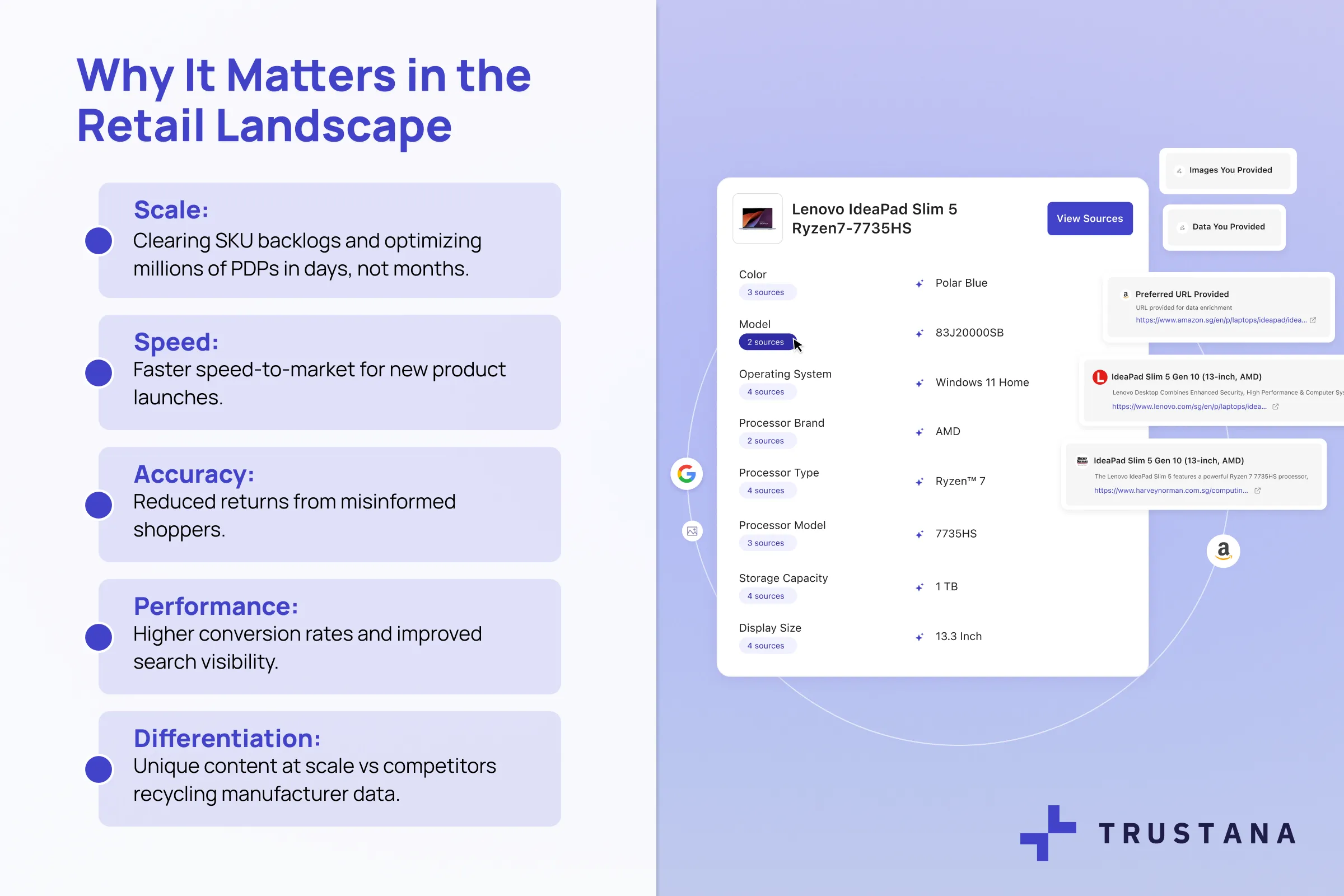
Enterprise retailers and marketplaces manage massive SKU counts, fragmented channels, and increasingly scrutinizing consumer expectations. Agentic e-commerce promises:
- Scale: Clearing SKU backlogs and optimizing millions of PDPs in days, not months.
- Speed: Faster speed-to-market for new product launches.
- Accuracy: Reduced returns from misinformed shoppers.
- Performance: Higher conversion rates and improved search visibility.
- Differentiation: Unique content at scale vs competitors recycling manufacturer data.
Challenges of Agentic E-commerce
Agentic e-commerce is about as far from "business as usual" as it gets when tihnking about tradtional buyer journeys. In this case, human browsing is no longer a factor. With discovery increasingly handled by AI agents that scan, compare, and decide in seconds, retailers are "marketing" to an entirely new audience. That puts enormous pressure on retailers to get their product data house in order. If information is inconsistent, incomplete, or scattered across siloed systems, agents will simply skip those offers.
Fragmented product data makes it hard for agents to evaluate offers consistently. Because many organizations lack standardized taxonomies or enrichment processes, their incomplete product data is a real risk of revenue loss.
Another big issue is the fact that Agents simply don't care about your brand, unless otherwise prompted to care. Storytelling doesn't matter to AI, these agents want structured data so they can get the job done for their bosses, the buyers.
Lastly, siloed teams and supply chain participants slow down the whole process, leaving gaps in both an orgnaization's readiness and the agent's buying journey that have to be closed.
Risks of Agentic E-commerce
The biggest risk with agentic commerce is invisibility. If your business isn’t prepared, you may be invisible when agents are making the calls on what products to buy. That risk comes with ripple effects: compressed margins, weaker control over the customer relationship, and lost ground to competitors who adapt faster.
When brands are no longer in control of the narrative, the story falls apart and the premium they once commanded may also crumble as agents optimize for price and availability. With this loss of control, discovery and loyalty shift away from brand-owned properties to 3rd-party and AI-driven platforms.
Poor or incomplete data can cause misrepresentation or regulatory issues, further putting brand and retailers at risk. When your products lack the necessary product attributes to comply, will your products be considered by AI buyers at all?
Rewards of Agentic E-commerce
The flip side is that retailers who act early can unlock seriously potent benefits. By becoming “agent-ready” before competitors, first-movers make themselves the preferred choice in a machine-driven marketplace. Cleaner product pages, accurate enrichment, and transparent policies help both agents and customers, which lifts conversion, reduces returns, and builds trust on multiple fronts.
What spoils are waiting for those who get onboard with agentic commerce early? Here's what they stand to gain:
- Higher conversion rates: Well-structured PDPs and complete data improve agent ranking and acpture more business.
- Operational efficiency: Automation of enrichment and syndication reduces manual effort, cutting costs.
- Customer trust: Accurate content and easy policies lower returns and increase loyalty.
- First-mover advantage: Early adopters earn lasting visibility as go-to partners for agents.
Agentic e-commerce interaction models
Google anticipates that new interaction models will emerge as core components of agentic e-commerce: Consumer-to-Merchant (C2M) and Merchant-to-Merchant (M2M) interactions.
Consumer-to-Merchant (C2M)
In this model, a consumer uses their own personal AI agent to act as a proxy when interacting with merchant-operated agents to fulfill information and purhcasing requests. Consider C2M as a consumers personal shopping assistant.
How does C2M work?
Let's say you want to take a trip to a specific region, where apparel is indeed highly specific depending on terrain, season, and other environmental factors. A consumer can prompt their agent: "I’m going to the to the Swiss alps in October. Can you recommend the best footwear and apparel to use as part of a hiking and skiing vacation?" The consumer's agent may query back for more details regarding activity intensity, budget, and other needs, then evaluate options across different merchants. All the while, this personal shopper is autonomously interacting with marketplace agents to discover appropriate apparel, inventory agents to determine size and availability, and payment agents ultimately complete the purchase and ship the products to the shopper's doorstep.
Merchant-to-Merchant (M2M)
In this model, a retailer’s AI agent interacts with other merchant agents to complete tasks. This can be considered a virtual employee, capable of extending retailer capabilities beyond their own limitations, such as headcount or hours of operation.
How does M2M work?
I we look to the above example for C2M, we can identify several opportunities for merchant agents to participate in the execution of commercial activities with consumer agents.
Let's take things a step further and imagine a scenario where a consumer agent has inquired about a product that is out of stock or not even in a merchant's catalog. Normally, a sale would be lost here. however, with M2M in action a retailer agent could interact with other retailers' agents to procure the product(s) in question, complete the sale, and ship the order. The result is a seamless customer experience and a new model by which merchants are no longer competitors but collaborators that can support one another in revenue generating activities.
From Unified to Agentic: What’s Changing
Agentic commerce takes the concept of unified commerce, where shoppers have consistent experiences across channels, one step further. Instead of simply streamlining the customer journey, it hands that journey over to AI agents that understand goals, interpret preferences, and transact autonomously. The result is a compressed buying funnel where visibility depends less on storefronts and more on whether agents can easily parse and trust your data. This shift is already underway as major platforms experiment with AI shopping agents that fill carts directly inside conversational apps.
Key points
- Definition: Agents that understand goals and transact autonomously, beyond chatbots or recommenders. Salesforce, Mirakl
- Shift described: Agents execute discovery > negotiation > purchase, compressing the funnel. Sameer Dhingra
- Market context: Platforms are piloting shopping agents that search and fill carts inside conversational apps. Financial Times
- Implication: Visibility depends more on machine-readable product data, availability, and pricing. TechRadar Pro
- Trust & governance: As “AI buys from AI,” transparency and controls are essential. TechRadar Pro
Agentic E-commerce Creates New Opportunities for Retailers
This new agent-driven world presents cahllenges for retailers that ultimately form exciting opportunities in the world of agentic e-commerce. Two such opportunites allow retailers to redefine the consumer experience and own it from end-to-end, as well as own transactions regardless of their origin. Here's how it plays out:
Owning the shopping experience end-to-end
With agentic e-commerce, the customer expeirence is reimagined. Retailers are empowered to create branded agentic experiences that power every element of the buyer journey, from discovery to purchase to loyalty.
By building the structure to guide intelligent agents, retailers can control the product discovery journey all theway through to the pointof purchase with cross sell and upsell opportunities along the way. Within this brranded experience, cross-retailer shopping becomes an environment for frictionless negotiation and personalization, improving satisfaction and brand affinity. Lastly, the loyalty built in this scenario enables further personalization opportunities for revenue capture based on consumer preferences and purchase history.
The means to capture every sale
Agentic commerce paves the way for stockouts to become a problem of the past. These agents are capable of sourcing products from other retailers in the desired sizes, styles, and quantities to fulfill orders without consumers ever knowing the handshakes and negotiations taking place in 1's and 0's between agents.
As the commerce network of agent-to-agent transactions proliferates, new standards for payments, checkout, and agent interoperability emerge. New specialization opportunities become available and products are now available wherever purchasing decisions take place.
Agentic-ready data: Product Content, PDP Quality, and Structured Data
AI agents don’t browse the internet like humans. They scan and evaluate inputs according to a specific structure. That means your PDPs must be complete, accurate, and machine-readable to even be considered. Today, most e-commerce sites still fall short. Nearly half of large US and EU retailers have mediocre PDP UX, global cart abandonment remains near 70%, and poor image quality continues to drive costly returns. By contrast, retailers that invest in enriched content, consistent schema, and clear images not only lift conversion but also reduce returns. For retailers, that's a direct bottom-line win.
Key points
- PDP UX headroom: Only 49% of top US/EU sites achieve “decent or good” PDP UX. Baymard
- Cart leakage: Global cart abandonment averages ~70.19%. Baymard
- Structured data: Adding
Productschema makes listings eligible for rich results. Google - Image quality reduces returns: High-resolution images lower expectation gaps. NielsenIQ
- Returns baseline: Retail returns were 14.5% of sales in 2023; online returns 17.6%. NRF, Narvar
Shameless plug: Retailers can use Trustana’s enrichment layer to standardize attributes, enrich content, and generate machine-readable data across PDPs, feeds, and agent surfaces.
Agent-Ready Supply, Pricing, and Policy: Automating the Retailer–Supplier Loop
For AI agents, accuracy and transparency are non-negotiable. They evaluate supply availability, shipping timelines, and policies automatically. If your data is incomplete or misaligned, your offers simply won’t surface. That makes supplier catalog accuracy, price consistency, and return policies not just operational concerns but visibility levers. Studies show consumers heavily factor returns friction into buying decisions, and “not as expected” remains one of the top reasons for returns. These are gaps that can be closed with better enrichment. At the same time, personalization remains a high-ROI lever, with McKinsey reporting 10–15% revenue lift when executed effectively.
Key points
- Clarity required: Agents weigh location, delivery, and price automatically; misalignment demotes visibility. Sameer Dhingra
- Policy transparency: Returns friction influences conversion and loyalty. NRF/Happy Returns
- Content–returns link: “Not as described” is a top return reason; accurate specs/images matter. Oberlo
- Personalization economics: Effective AI-driven personalization delivers 10–15% revenue lift; promotions add 1–3% margin. McKinsey, McKinsey
Shameless plug: Trustana can harmonize supplier data, align pricing/policy metadata, and expose consistent, agent-ready feeds.
Measurement, Governance, and ROI: Running Agentic Commerce Like a System
Agentic e-commerce can’t be managed ad hoc, it requires discipline and measurable KPIs. Eligibility for rich results, structured data accuracy, checkout performance, and return rates are the levers that drive profitability. Baymard research shows that improving checkout UX alone can increase conversion by 35%. Pair this with structured data monitoring in Search Console, realistic return benchmarks, and KPIs like agent pick-rate and PDP completeness, and retailers can quantify the ROI of their investments.
Key points
- SEO/AEO hygiene: Track structured-data validity via Search Console rich results.
- Checkout ROI: Optimizing checkout can increase conversion by up to 35%. Baymard
- Returns cost: Online returns remain higher than in-store. NRF, Narvar
- KPIs to track: rich-result coverage, PDP completeness score, agent pick-rate, AOV, margin, return reasons mix.
Shameless plug: Trustana’s platform helps unify enrichment workflows, schema coverage, and feed accuracy for agent readiness.
Trustana’s Role in Agentic E-commerce
Trustana is a foundational enabler of agentic e-commerce, turning enrichment into an autonomous, intelligent process rather than a manual slog. With Trustana, retailers no longer just “store product data”; they deploy agents to enrich, optimize, and govern content at scale, ensuring their digital shelf is always optimized for discovery and conversion.
Agentic e-commerce rewards retailers who prepare for a future where machines are the first customer. By investing in enriched, structured product data, aligning return policies, and measuring ROI rigorously, retailers can gain visibility and trust with AI agents. With an enrichment layer like Trustana, businesses can operationalize these practices at scale and position themselves well ahead of the curve.