
What Is an AI-Native PIM? A Practical Guide for E-commerce Teams

Discover how AI-native PIM platforms automate product data enrichment, improve search visibility, and prepare your catalog for AI-driven commerce.

This feature is available for customers on the

Tier or higher. Reach out to book a demo with our sales team today.

This feature is available for customers on the

Tier. Reach out to book a demo with our sales team today.

What Is an AI-Native PIM? A Practical Guide for E-commerce Teams

On this page

You’ve probably noticed the conversation around e-commerce technology has shifted focus to AI-native PIM, product content enrichment, and AI-ready catalogs.

It's primarily being driven by pressure. Pressure to:

  • Launch more products, faster
  • Improve search visibility across more channels
  • Support AI-driven discovery and recommendations
  • Do it all without increasing headcount

At the same time, the supplier product data and internal product data e-commerce teams rely on still arrives in their systems as messy, incomplete, and inconsistent.

That’s the problem AI PIM is designed to solve.

This article breaks down what and AI PIM is, how it works, and how it compares to traditional PIM systems and enrichment platforms.

What Is an AI PIM?

An AI-native PIM (Product Information Management system) is a platform built to automatically structure, enrich, and optimize product data using AI and automation at its core.

It goes beyond storing product data to improve its quality and enable its activation across every channel those products may appear for purchase and customer research.
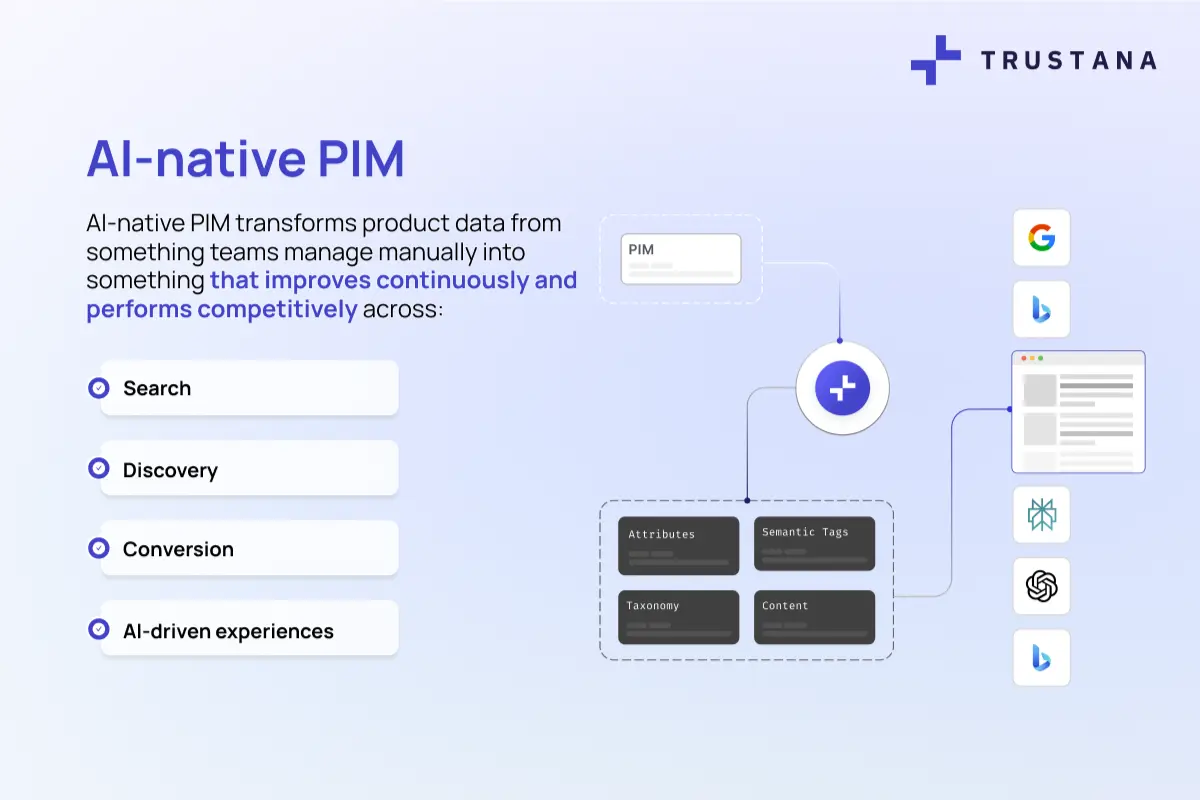
The idea of PIMs is evolving from a system of record to a system of intelligence, transforming raw supplier inputs into:

Why an AI-Native PIM Matters for Modern E-commerce

Most e-commerce teams struggle because their product data isn’t ready for how commerce actually works today.

A few years ago, ranking products was largely about ranking for keywords in search engines to ensure your product was on the top of SERPs. That model is quickly breaking down in favor of a more conversational research model.

Search engines like Google Search and AI assistants like ChatGPT now interpret intent, context, and relationships between attributes, matching those elements to shopper queries as they research the products they want to buy.

If your product data is incomplete or inconsistent, these systems can’t understand it. And if they can’t understand it, they won’t recommend it to shoppers as part of their search.

It becomes a fundamental question of whether or not your data is prepared for AI so that it can be used to recommend your products in the new age of e-commerce.

The Bottleneck Becomes Readiness

Teams often invest heavily in traffic acquisition, but that's only part of the challenge. Sure, getting eyes on your products is one thing, but once they are there how do you convince the buyer this product fits their job to be done? This is when retailers come to realize the real constraint is internal.

When products are presented to potential buyers with missing attributes, inconsistent formats, and generic descriptions, that creates immense friction across the entire buying journey. Confidence drops and carts get abandoned.

An AI-native PIM reframes the problem: Are your products actually ready to be discovered, filtered, compared, and chosen?

Until that answer is yes, more traffic won’t fix performance.

AI Decides What Gets Seen

Product discovery is increasingly mediated by AI. Recommendation engines, guided selling tools, and emerging agent-driven experiences decide what products are surfaced and prioritized in connection with a buyer's search.

Marketing copy is no longer enough to convince these systems your product is the right one to recommend. Because these systems rely on structured, machine-readable data, it takes a lot more than standard attribute values from a generic catalog to be seen. This is especially true of supplier product data, that often includes generic descriptions forwarded to everyone that sells those same SKUs.

Manual Workflows Hit a Ceiling

Every e-commerce team eventually runs into the same ceiling. More SKUs means more:

  • Data cleanup
  • Attribute mapping
  • Content creation
  • QA cycles

At scale, the only options are to hire more people or outsource the work. Both introduce costs and inconsistencies. It's just the price of doing business when it comes to manual data entry.

An AI-native PIM changes the model entirely. Instead of processing products one-by-one, an AI PIM processes catalogs as a system, with humans guiding outputs rather than creating them from scratch. It's much more efficient, compreensive, and impactful.

Product Data Becomes the Growth Lever

Product data is no longer playing a supporting role in e-commerce. It has squarely become a strategic lever and the better it gets, the better teams come to realize:

  • Faster discovery
  • Stronger differentiation
  • Higher conversion

And perhaps more importantly, it all compounds over time. So, the sooner these advancements can be introduced into the workflow, the sooner and greater the results are realized.

PIM vs AI-Native PIM vs Enrichment Platforms

There's no shortage of confusion around AI and it's influence on retail and e-commerce. When talking about the tools influencing those ecosystems, PIM, AI-native PIM, and enrichment platforms, it only expands. While the categories overlap, they are not the same.
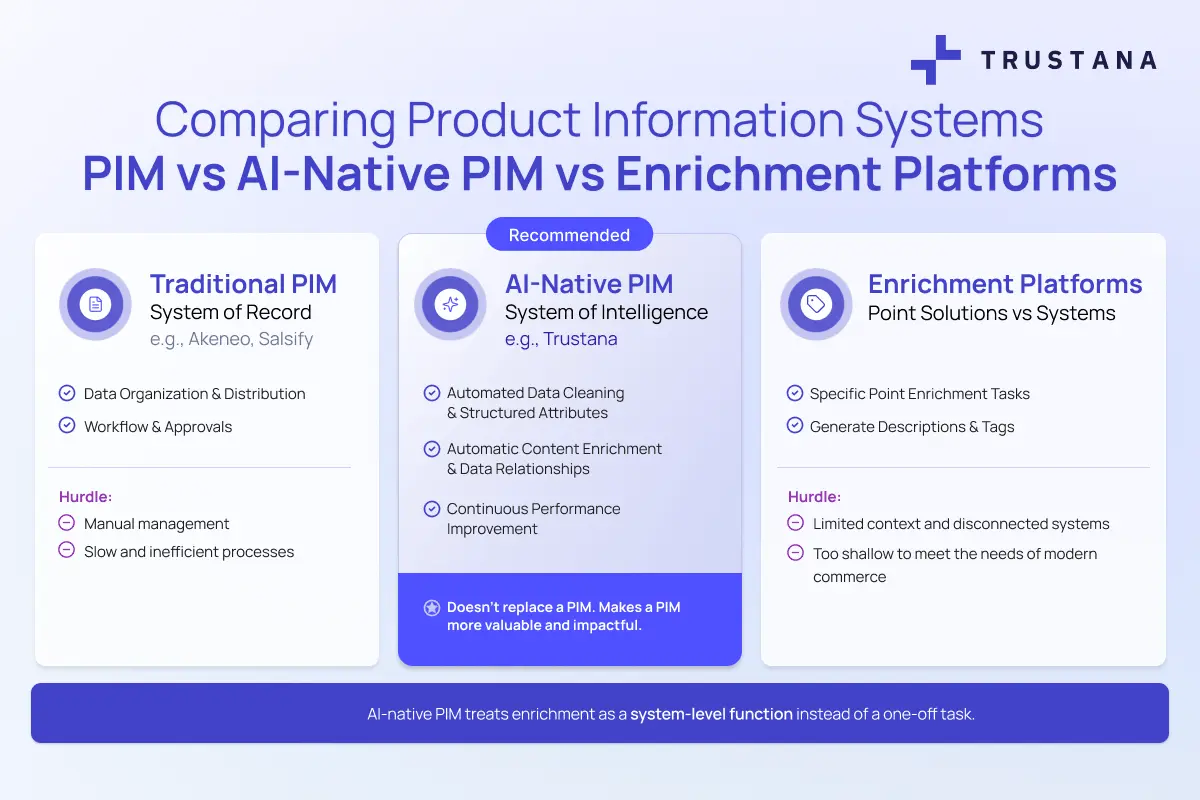
Here's how it shakes out:

Traditional PIM (System of Record)

Platforms like Akeneo or Salsify are designed to organize and distribute product data. They help teams:

  • Store product information
  • Maintain consistency across channels
  • Manage workflows and approvals

The hurdle these systems run into is they rely heavily on manual enrichment or external inputs.

AI-Native PIM (System of Intelligence)

AI-native PIM sits on top of or alongside existing systems and focuses on improving the data itself. Trustana fits into this category because the platform:

  • Cleans messy supplier inputs
  • Generates structured attributes
  • Enriches content automatically
  • Builds relationships across the catalog
  • Continuously improves based on performance

It doesn’t replace a PIM. It makes a PIM more valuable and more impactful.

Enrichment Platforms (Point Solutions vs Systems)

Some tools focus specifically on enrichment, but often as point solutions. Even then, the term "enrichment" is often used as a generic, catch-all term between solution providers. Many of whom simply take on the process of enriching data manually form a price.

These solution providers may generate descriptions, extract attributes, and assist with tagging. However, they typically lack full catalog context, continuous learning loops, and deep integration into workflows. They're too shallow in terms of operational capability to meet the needs of modern commerce. They also don't have full context into how your business actually operates. Further miring the organization in a sea of similarity.

An AI-native PIM differs by treating enrichment as a system-level function instead of a one-off task. Here's a more structured comparison of those systems side-by-side.

Capability Traditional PIM Enrichment Tools AI-Native PIM
Core role Store and manage product data Assist with specific content or attribute tasks Improve, structure, and optimize product data
Enrichment approach Mostly manual workflows Partial or task-based automation Automated, system-level enrichment
Context awareness Limited Low High
Scalability Limited by workflow and headcount Limited by point-solution scope Built to scale across large catalogs
AI readiness Low Medium High
Continuous improvement No Minimal Built in

Where AI-Native PIM Fits in Your Stack

For most teams, AI-native PIM is a missing layer that sits between:

  • Raw supplier data (ERP, feeds, PDFs)
  • Systems of record (PIM, e-commerce platforms)

Think of it like water filtration sitting between the source and the tap. Raw supplier data comes in unfiltered. After passing through the refinement/filtration layer, what reaches your storefront is clean, structured, and ready to use.

Its role is simple but critical: Turn messy inputs into structured, enriched, AI-ready product data before it reaches your storefront.

This Is a Data Problem, Not a Tool Problem

Most teams don’t have a PIM problem, they have a product data quality and scalability problem.

AI-native PIM directly addresses that pain felt by so many retailers in B2B and B2C e-commerce at the source.

It transforms product data from something teams manage manually into something that improves continuously and performs competitively across:

  • Search
  • Discovery
  • Conversion
  • AI-driven experiences

As AI increasingly becomes the primary interface for product discovery and online shopping, better data and the advancements AI-native PIM bestows become a business imperative.

If you're ready to enter the next era of e-commerce with an AI-native PIM, get in touch with an expert on the Trustana team and Book a Demo today.
AI-Native PIM, Product Data, and AI-Driven Commerce FAQ

How do you evaluate whether your product data is “AI-ready”?

AI-ready product data is structured, complete, and context-rich enough for machines to interpret without ambiguity. In practice, that means consistent attribute coverage across SKUs, standardized taxonomy, clear relationships between products, and content that reflects real-world use cases. A simple test is whether your data can support filtering, semantic search, and recommendations without manual intervention. If not, it’s not AI-ready.

What breaks first when product data isn’t structured properly?

Search and filtering usually fail first. Shoppers can’t narrow results effectively, leading to zero-result searches or irrelevant listings. From there, recommendation engines degrade, PDP clarity drops, and conversion suffers. Internally, teams also feel the impact through manual fixes, inconsistent outputs, and slower product launches.

Can AI-generated product content hurt SEO or rankings?

It can if it’s generic, inconsistent, or disconnected from structured data. Search systems prioritize clarity, relevance, and alignment with user intent. AI-generated content performs best when it’s grounded in accurate attributes, enriched with context, and differentiated from manufacturer copy. The risk isn’t AI itself. It’s using AI without a structured data foundation.

What is the difference between structured, factual, and intelligent attributes?

Structured attributes define standardized product properties like size or material. Factual attributes capture verifiable details such as compatibility or certifications. Intelligent attributes add context, such as use cases, buying signals, or semantic tags. Together, they allow both humans and AI systems to understand not just what a product is, but when and why it should be chosen.

Why do most AI initiatives in ecommerce fail at the product data layer?

Because the underlying data is incomplete or inconsistent. AI systems depend on clean, structured inputs. When product data varies across SKUs, lacks key attributes, or uses inconsistent formats, outputs become unreliable. This leads to poor recommendations, weak search performance, and low trust in AI-driven experiences.

How does AI-native PIM impact product onboarding speed?

It removes the need for manual enrichment before products go live. Instead of waiting for teams to clean and structure data, AI processes incoming information automatically and prepares it for use across channels. This shifts onboarding from a linear, human-dependent workflow to a parallel, system-driven process.

What role does product data play in conversion rates?

Product data directly influences how confidently a customer can make a decision. Clear specifications, complete attributes, and relevant content reduce uncertainty. When shoppers can easily find, compare, and understand products, they’re more likely to convert. Poor data introduces friction, which leads to drop-off.

How does AI-native PIM support multi-channel commerce?

It standardizes and enriches product data so it can be adapted to different channel requirements without manual rework. Whether it’s ecommerce sites, marketplaces, or emerging AI interfaces, the same structured foundation can be reused and optimized for each environment.

What is the relationship between product data and answer engine optimization (AEO)?

AEO depends on structured, context-rich data that can be interpreted by AI systems generating direct answers. Product data that includes clear attributes, use cases, and semantic meaning is more likely to be surfaced in AI-generated responses. Without that structure, products are less likely to be included in answer-based results.

How do you measure ROI from improving product data quality?

ROI typically shows up in four areas: faster time-to-market, improved search visibility, higher conversion rates, and reduced manual workload. Metrics like product onboarding time, search success rate, PDP conversion, and content production efficiency provide a clear picture of impact.

Can AI-native PIM integrate with existing PIM or ERP systems?

Yes. It is typically designed to sit between raw data sources and systems of record. It enhances the quality of data before it flows into your PIM, ecommerce platform, or other downstream systems, rather than replacing them entirely.

What happens if you don’t improve your product data now?

The gap compounds over time. As competitors improve their data and AI systems become more influential in discovery, poorly structured catalogs become harder to find and less competitive when they are found. What starts as a performance issue becomes a visibility problem.

How does product data influence AI-driven recommendations?

Recommendation systems rely on attributes, relationships, and contextual signals to match products to user intent. If those signals are missing or inconsistent, recommendations become less relevant. High-quality product data improves both precision and confidence in what gets suggested.

What should ecommerce teams prioritize first when modernizing product data?

Start with attribute completeness and consistency across your catalog. Without a strong structured foundation, enrichment and AI initiatives will produce inconsistent results. Once the structure is in place, teams can layer on enrichment, optimization, and performance feedback loops.

Is AI-native PIM relevant for smaller catalogs or only large enterprises?

While the impact scales with catalog size, smaller teams often benefit sooner because they can eliminate manual processes early. It allows them to compete with larger players without needing equivalent headcount or resources.

Get an Expert Review of Your Product Data

Get practical guidance on improving catalog quality, enrichment workflows, and AI readiness based on your current setup.

AI PIM (AI-Powered Product Information Management)
ai-pim-ai-powered-product-information-management
Enrichment Layer
enrichment-layer
Large Language Model (LLM)
large-language-model-llm
Dynamic Synthesis
dynamic-synthesis
Operational Layer
operational-layer
Evidence Layer
evidence-layer
Probabilistic Accuracy
probabilistic-accuracy
Deterministic accuracy
deterministic-accuracy
Product Attribute
product-attribute
Intelligent Product Attribute
intelligent-product-attribute
Factual Product Attribute
factual-product-attribute
Structured Product Attribute
structured-product-attribute
Google MCP (Model Context Protocol)
google-mcp-model-context-protocol
Retrieval-Augmented Generation (RAG)
retrieval-augmented-generation-rag
Product Data Activation (PDA)
product-data-activation-pda
Product Data Architecture (PDA)
product-data-architecture-pda
Context Graph
context-graph
Buy to Detail Rate (BTD)
buy-to-detail-rate-btd
White Label Product
white-label-product
User Experience (UX)
user-experience-ux
UPC (Universal Product Code)
upc-universal-product-code
Third-Party Marketplace
third-party-marketplace
Syndication
syndication
Structured Data
structured-data
Sell-Through Rate
sell-through-rate
Stale Content
stale-content
Search Relevance
search-relevance
Search Merchandising
search-merchandising
SKU-Level Analytics
sku-level-analytics
SKU Rationalization
sku-rationalization
SKU Performance
sku-performance
SKU (Stock Keeping Unit)
sku-stock-keeping-unit
SEO (Search Engine Optimization)
seo-search-engine-optimization
Rich Media
rich-media
Retailer Portal
retailer-portal
Retail Media
retail-media
Retail Content Syndication
retail-content-syndication
Repricing Tool
repricing-tool
Retail Analytics
retail-analytics
Replatforming
replatforming
Real-Time Updates
real-time-updates
Quality Assurance (QA)
quality-assurance-qa
Product Visibility
product-visibility
Product Variant
product-variant
Product Validation
product-validation
Product Upload
product-upload
Product Title Optimization
product-title-optimization
Product Taxonomy Tree
product-taxonomy-tree
Product Taxonomy
product-taxonomy
Product Tagging
product-tagging
Product Syndication Lag
product-syndication-lag
Product Syndication
product-syndication
Product Schema
product-schema
Product Status Tracking
product-status-tracking
Product Page Bounce Rate
product-page-bounce-rate
Product Onboarding
product-onboarding
Product Metadata
product-metadata
Product Matching
product-matching
Product Lifecycle Stage
product-lifecycle-stage
Product Information Management (PIM)
product-information-management-pim
Product Lifecycle Management (PLM)
product-lifecycle-management-plm
Product Info Templates
product-info-templates
Product Import
product-import
Product Feed Validation
product-feed-validation
Product Feed Scheduling
product-feed-scheduling
Product Feed
product-feed
Product Family
product-family
Product Discovery
product-discovery
Product Export
product-export
Product Dimension Attributes
product-dimension-attributes
Product Detail Page (PDP)
product-detail-page-pdp
Product Description
product-description
Product Data Versioning
product-data-versioning
Product Data Syndication Platforms
product-data-syndication-platforms
Product Data Sheet
product-data-sheet
Product Data Quality
product-data-quality
Product Content Management (PCM)
product-content-management-pcm
Product Data Harmonization
product-data-harmonization
Product Content Enrichment
product-content-enrichment
Product Comparison
product-comparison
Product Compliance
product-compliance
Product Channel Fit
product-channel-fit
Product Categorization
product-categorization
Product Bundling
product-bundling
Product Badging
product-badging
Product Attributes
product-attributes
Product Attribute Completeness
product-attribute-completeness
Price Scraping
price-scraping
Personalization
personalization
PDP Optimization
pdp-optimization
PDP Heatmap
pdp-heatmap
PDP Conversion Rate
pdp-conversion-rate
Out-of-Stock Alerts
out-of-stock-alerts
Omnichannel
omnichannel
Omnichannel Strategy
omnichannel-strategy
Net New SKU Creation
net-new-sku-creation
Multichannel Retailing
multichannel-retailing
Metadata
metadata
Mobile Optimization
mobile-optimization
Merchant-to-Merchant (M2M)
merchant-to-merchant-m2m
Marketplace Listing Errors
marketplace-listing-errors
Marketplace Reconciliation
marketplace-reconciliation
Marketplace Compliance
marketplace-compliance
Marketplace
marketplace
MAP Pricing (Minimum Advertised Price)
map-pricing-minimum-advertised-price
Localization Tags
localization-tags
Long-Tail Keywords
long-tail-keywords
Listing Optimization
listing-optimization
Lifecycle Automation
lifecycle-automation
Key Performance Indicator (KPI)
key-performance-indicator-kpi
Inventory Management
inventory-management
Intelligent Search
intelligent-search
Image Optimization
image-optimization
Hyperpersonalization
hyperpersonalization
Headless Commerce
headless-commerce
Generative Engine Optimization (GEO)
generative-engine-optimization-geo
Generative AI
generative-ai
Fuzzy Search
fuzzy-search
GTM (Go-to-Market) Strategy
gtm-go-to-market-strategy
GTIN (Global Trade Item Number)
gtin-global-trade-item-number
Flat File
flat-file
First-Party Data
first-party-data-a51e9
First-Party Data
first-party-data
First-Mile Fulfillment
first-mile-fulfillment
Feed Testing Environment
feed-testing-environment
Feed-Based Advertising
feed-based-advertising
Feed Optimization Tool
feed-optimization-tool
Feed Management
feed-management
Feed Diagnostics
feed-diagnostics
Faceted Search
faceted-search
ERP (Enterprise Resource Planning)
erp-enterprise-resource-planning
Explainable AI
explainable-ai
Enrichment Rules
enrichment-rules
Enhanced Brand Content (EBC)
enhanced-brand-content-ebc
EPID (eBay Product ID)
epid-ebay-product-id
EAN (European Article Number)
ean-european-article-number
E-commerce Platform
e-commerce-platform
Dynamic Pricing
dynamic-pricing
Duplicate Content
duplicate-content
Direct-to-Consumer (DTC)
direct-to-consumer-dtc
Drop Shipping
drop-shipping
Digital Transformation
digital-transformation
Digital Shelf
digital-shelf
Digital Asset Management (DAM)
digital-asset-management-dam
Data Syncing
data-syncing
Data Normalization
data-normalization
Data Mapping
data-mapping
Data Governance
data-governance
Data Feed Transformation
data-feed-transformation
Data Feed Rules
data-feed-rules
Data Feed Error Report
data-feed-error-report
Data Enrichment Pipeline
data-enrichment-pipeline
Data Drift
data-drift
Data Deduplication
data-deduplication
Data Clean-up
data-clean-up
Customer Experience (CX)
customer-experience-cx
Conversion Rate
conversion-rate
Content Scalability
content-scalability
Content Localization
content-localization
Content Governance
content-governance
Content Gaps
content-gaps
Consumer-to-Merchant (C2M)
consumer-to-merchant-c2m
Channel-Specific Optimization
channel-specific-optimization
Channel Readiness
channel-readiness
Category Mapping
category-mapping
Catalog Management
catalog-management
Buy Now, Pay Later (BNPL)
buy-now-pay-later-bnpl
Breadcrumb Navigation
breadcrumb-navigation
Automated Categorization
automated-categorization
Automated Content Generation
automated-content-generation
Automated Workflows
automated-workflows
Blacklisting (in feeds)
blacklisting-in-feeds
Attribution Tags
attribution-tags
Attribute Standardization
attribute-standardization
Answer Engine Optimization (AEO)
answer-engine-optimization-aeo
Artificial Intelligence (AI)
artificial-intelligence-ai
Attribute Mapping
attribute-mapping
Agentic E-commerce
agentic-e-commerce
A/B Testing
a-b-testing
API (Application Programming Interface)
api-application-programming-interface
AI Overviews
ai-overviews
AI Tagging
ai-tagging
AI Agents
ai-agents
AI Indexing
ai-indexing