June 25, 2025

PDP Optimization in the Age of AI

Discover how enriched product data and structured content transform PDPs. Learn why AI-ready product pages drive higher conversions, reduce returns, and boost visibility.

Marketing Manager - Trustana

This feature is available for customers on the

Tier or higher. Reach out to book a demo with our sales team today.

This feature is available for customers on the

Tier. Reach out to book a demo with our sales team today.

PDP Optimization in the Age of AI

Table of Contents

The product detail page (PDP) is where decisions happen. Shoppers arrive here with intent, and in a matter of seconds, they decide whether to add to cart, continue browsing, or abandon entirely. In many cases, it is the first and only page they see before making a purchase decision. For retailers investing in AI-driven experiences, the PDP is where all that investment must pay off.

Why the PDP Is the Moment of Truth

Too many PDPs remain under-optimized. They lack complete attributes, high-quality imagery, and structured data that AI systems require to deliver relevant results. Even with advanced AI layered on top, poor PDP content results in the same outcome: lower conversions and higher returns. Optimizing PDPs is not just a design exercise, it is the critical step in making product data AI-ready.

Enriched PDPs consistently outperform on conversion, engagement, return reduction, and organic visibility.

What AI-Driven PDPs Look Like

An AI-ready PDP is not static, it is enriched, dynamic, and tailored to the shopper’s needs. These pages deliver context and clarity that reduce hesitation and increase trust.

AI-driven PDPs often include:

  • Complete Attribute Sets: Shoppers can filter and compare based on all the details that matter, such as size, material, and use case.
  • Dynamic Content Blocks: Recommendations, reviews, and related items update based on shopper behavior.
  • Answer-Ready Information: Schema markup ensures PDPs feed into AI-driven answer boxes and marketplace discovery engines.
  • Personalized Elements: AI can surface content or attributes most relevant to a specific shopper segment, but only if the data foundation exists.

When PDPs are built this way, they do more than showcase a product, they create confidence and accelerate the buying decision.

Elements That Depend on Data

The strength of a PDP depends less on creative design and more on the quality of the data behind it. Every element that influences conversions is data-driven.

Key elements include:

  • Images and Visuals: High-resolution, multi-angle, and lifestyle images require consistent metadata and alignment to product attributes.
  • Reviews and Ratings: Customer feedback must be linked to the correct products with structured identifiers.
  • User-Generated Content: Photos, Q&A, and social proof only add value if tied to enriched product data.
  • Attributes and Specs: Details such as dimensions, materials, compatibility, and use cases are essential for filtering and decision-making.
  • Schema Compliance: Structured markup ensures PDPs can be indexed by search and AI-driven answer engines.

Without complete, accurate, and consistent data powering these elements, PDPs cannot fulfill their role in the buying journey.

Conversion Benchmarks from Enriched PDPs

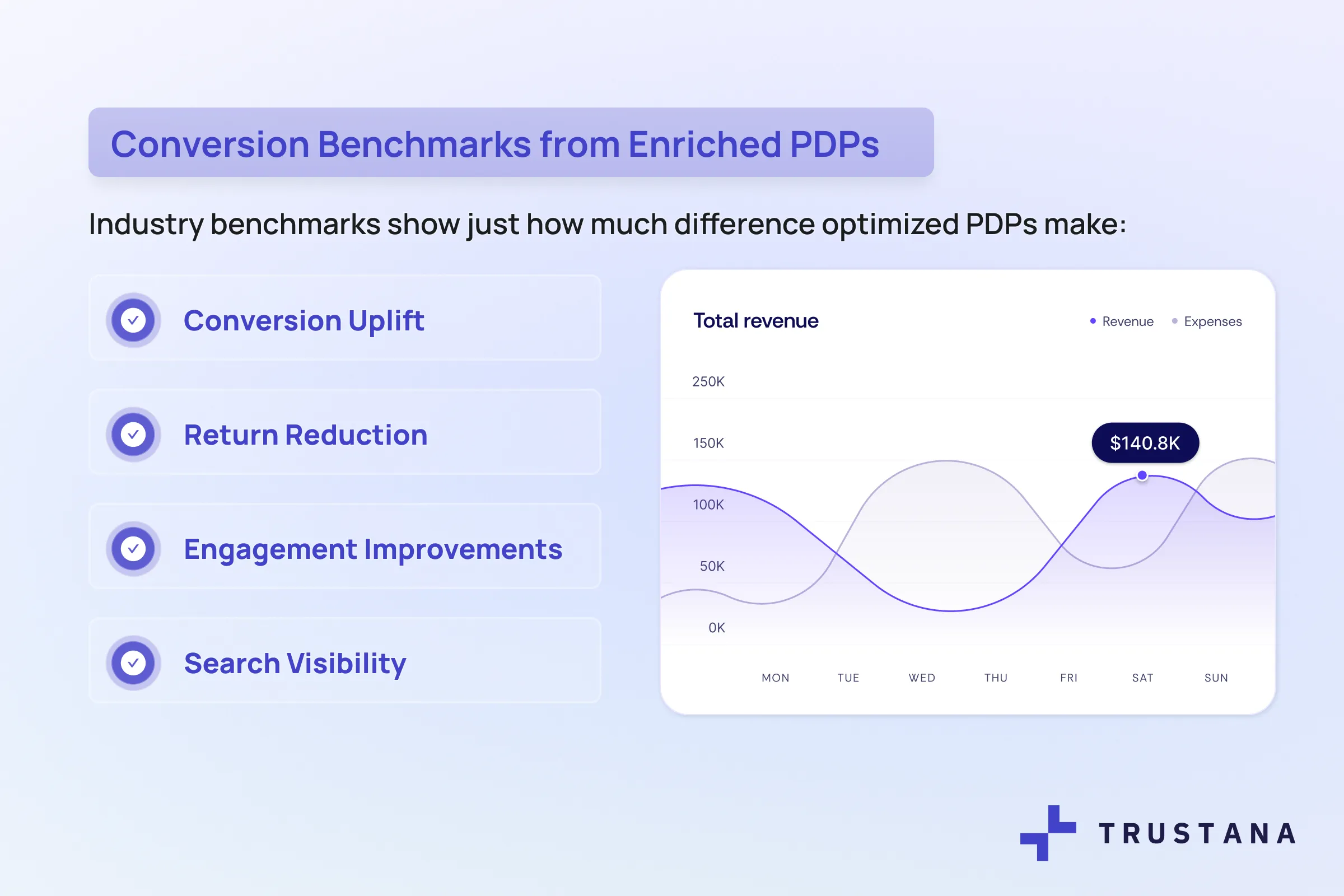
Industry benchmarks show just how much difference optimized PDPs make:

  • Conversion Uplift: Optimized PDPs with complete attributes can increase conversion rates significantly. Trustana routinely sees a double-dgit uplift in conversions following PDP enrichment.
  • Return Reduction: Accurate sizing and enriched product details reduce return rates, particularly in apparel and footwear categories where expectation mismatches are common.
  • Engagement Improvements: Adding user-generated content like reviews, Q&A, and social images increases conversion thanks to the social proof aspects of this content supporting purhcasing decisions.
  • Search Visibility: Schema-compliant PDPs improve rankings in both traditional and AI-driven search, increasing traffic without additional ad spend.

For executives, these numbers demonstrate that PDP optimization is not a marginal gain, it is a revenue driver with measurable ROI.
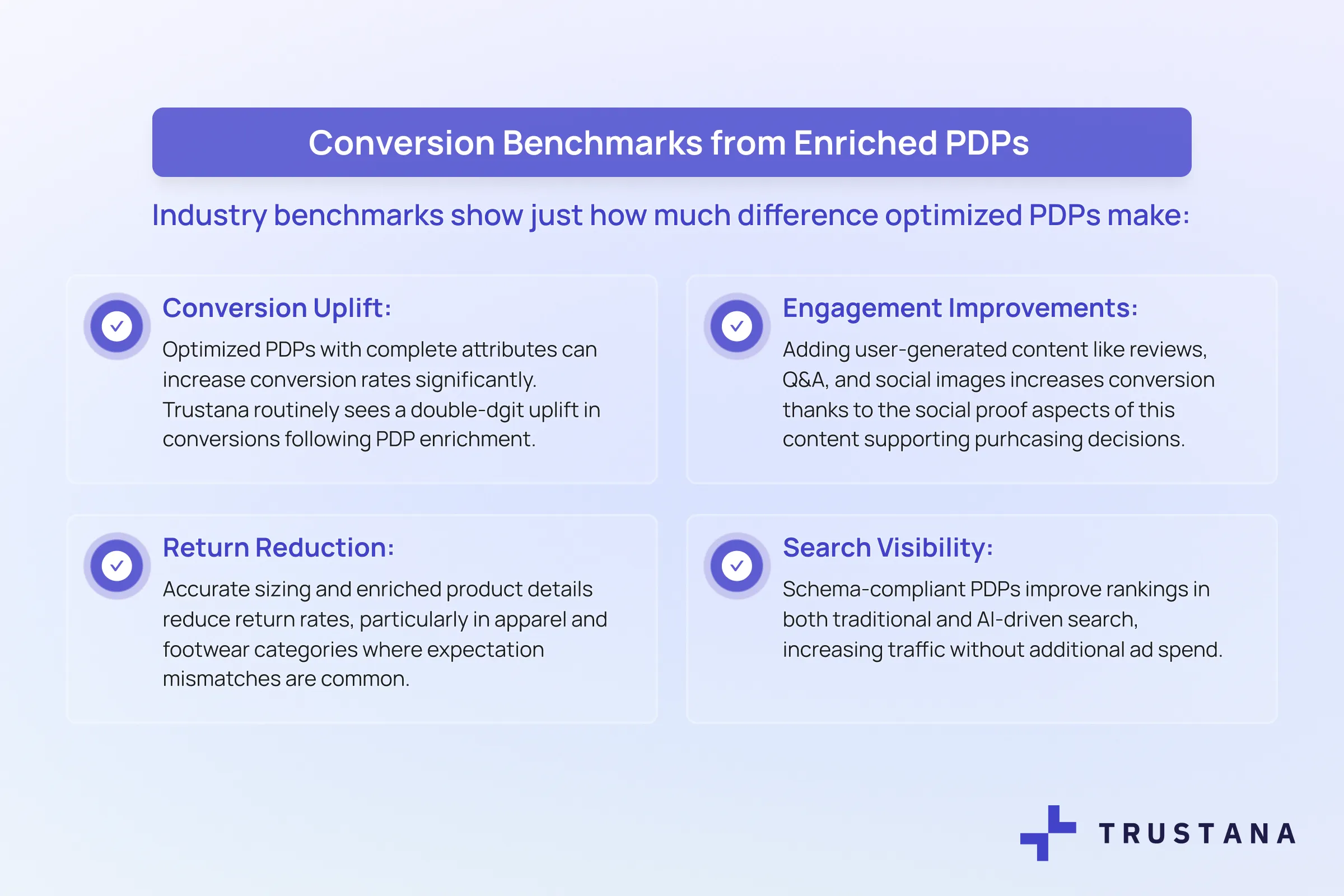
Diagram illustrating how optimized product data improves PDP performance and buyer decision confidence.

Building PDPs That Scale with AI Tools

Optimizing one PDP is manageable. Scaling improvements across thousands of SKUs is the real challenge. This is where AI tools, automation, and governance processes make the difference.

Steps to scale include:

  1. Audit Current PDP Performance: Identify conversion bottlenecks, missing attributes, and inconsistent imagery.
  1. Automate Enrichment: Use AI-powered enrichment to fill gaps in product data and standardize attributes.
  1. Standardize Schema Markup: Apply consistent structured data across all PDPs to enable AI-driven visibility.
  1. Incorporate Dynamic Content: Integrate review blocks, recommendations, and personalized elements to keep PDPs fresh.
  1. Embed Governance: Create processes for continuous monitoring, ensuring that new SKUs launch AI-ready from day one.

By embedding these steps into digital operations, retailers can ensure that PDPs scale in quality alongside AI investments.

PDPs Prove Whether AI Is Ready or Not

The product detail page is the ultimate proving ground for AI readiness. If a PDP is incomplete, inconsistent, or under-optimized, it does not matter how advanced the AI system on top is. Customers will see flaws, lose confidence, and abandon. If the PDP is enriched, structured, and dynamic, AI can amplify its strengths and deliver the conversions executives expect.

For retail leaders, optimizing PDPs should not be seen as optional. It is the cornerstone of e-commerce performance and the most visible reflection of whether AI-readiness efforts are working.

For a complete roadmap, explore the AI-Readiness for Retail Guide.
PDP Optimization FAQ

Why are PDPs so critical for retail AI readiness?

Because they are where shoppers make purchase decisions. A poorly optimized PDP directly reduces conversions and increases returns.

What elements of a PDP depend on clean product data?

Images, attributes, specifications, reviews, user-generated content, and schema markup all rely on structured product data.

How much can optimized PDPs lift conversions?

Benchmarks show improvements of 20 to 40 percent when attributes are complete and enriched.

What role does schema markup play in PDP optimization?

It enables PDPs to be indexed correctly by search and AI-driven answer engines, improving visibility and traffic.

How can retailers scale PDP improvements across large catalogs?

Through AI-powered enrichment, schema standardization, dynamic content integration, and strong governance processes.

Subscribe to our newsletter today

Lorem ipsum dolor sit amet consectetur nulla augue arcu pellentesque eget ut libero aliquet ut nibh.

Retrieval-Augmented Generation (RAG)
retrieval-augmented-generation-rag
Product Data Activation (PDA)
product-data-activation-pda
Product Data Architecture (PDA)
product-data-architecture-pda
Context Graph
context-graph
Buy to Detail Rate (BTD)
buy-to-detail-rate-btd
White Label Product
white-label-product
User Experience (UX)
user-experience-ux
UPC (Universal Product Code)
upc-universal-product-code
Third-Party Marketplace
third-party-marketplace
Syndication
syndication
Structured Data
structured-data
Sell-Through Rate
sell-through-rate
Stale Content
stale-content
Search Relevance
search-relevance
Search Merchandising
search-merchandising
SKU-Level Analytics
sku-level-analytics
SKU Rationalization
sku-rationalization
SKU Performance
sku-performance
SKU (Stock Keeping Unit)
sku-stock-keeping-unit
SEO (Search Engine Optimization)
seo-search-engine-optimization
Rich Media
rich-media
Retailer Portal
retailer-portal
Retail Media
retail-media
Retail Content Syndication
retail-content-syndication
Repricing Tool
repricing-tool
Retail Analytics
retail-analytics
Replatforming
replatforming
Real-Time Updates
real-time-updates
Quality Assurance (QA)
quality-assurance-qa
Product Visibility
product-visibility
Product Variant
product-variant
Product Validation
product-validation
Product Upload
product-upload
Product Title Optimization
product-title-optimization
Product Taxonomy Tree
product-taxonomy-tree
Product Taxonomy
product-taxonomy
Product Tagging
product-tagging
Product Syndication Lag
product-syndication-lag
Product Syndication
product-syndication
Product Schema
product-schema
Product Status Tracking
product-status-tracking
Product Page Bounce Rate
product-page-bounce-rate
Product Onboarding
product-onboarding
Product Metadata
product-metadata
Product Matching
product-matching
Product Lifecycle Stage
product-lifecycle-stage
Product Information Management (PIM)
product-information-management-pim
Product Lifecycle Management (PLM)
product-lifecycle-management-plm
Product Info Templates
product-info-templates
Product Import
product-import
Product Feed Validation
product-feed-validation
Product Feed Scheduling
product-feed-scheduling
Product Feed
product-feed
Product Family
product-family
Product Discovery
product-discovery
Product Export
product-export
Product Dimension Attributes
product-dimension-attributes
Product Detail Page (PDP)
product-detail-page-pdp
Product Description
product-description
Product Data Versioning
product-data-versioning
Product Data Syndication Platforms
product-data-syndication-platforms
Product Data Sheet
product-data-sheet
Product Data Quality
product-data-quality
Product Content Management (PCM)
product-content-management-pcm
Product Data Harmonization
product-data-harmonization
Product Content Enrichment
product-content-enrichment
Product Comparison
product-comparison
Product Compliance
product-compliance
Product Channel Fit
product-channel-fit
Product Categorization
product-categorization
Product Bundling
product-bundling
Product Badging
product-badging
Product Attributes
product-attributes
Product Attribute Completeness
product-attribute-completeness
Price Scraping
price-scraping
Personalization
personalization
PDP Optimization
pdp-optimization
PDP Heatmap
pdp-heatmap
PDP Conversion Rate
pdp-conversion-rate
Out-of-Stock Alerts
out-of-stock-alerts
Omnichannel
omnichannel
Omnichannel Strategy
omnichannel-strategy
Net New SKU Creation
net-new-sku-creation
Multichannel Retailing
multichannel-retailing
Metadata
metadata
Mobile Optimization
mobile-optimization
Merchant-to-Merchant (M2M)
merchant-to-merchant-m2m
Marketplace Listing Errors
marketplace-listing-errors
Marketplace Reconciliation
marketplace-reconciliation
Marketplace Compliance
marketplace-compliance
Marketplace
marketplace
MAP Pricing (Minimum Advertised Price)
map-pricing-minimum-advertised-price
Localization Tags
localization-tags
Long-Tail Keywords
long-tail-keywords
Listing Optimization
listing-optimization
Lifecycle Automation
lifecycle-automation
Key Performance Indicator (KPI)
key-performance-indicator-kpi
Inventory Management
inventory-management
Intelligent Search
intelligent-search
Image Optimization
image-optimization
Hyperpersonalization
hyperpersonalization
Headless Commerce
headless-commerce
Generative Engine Optimization (GEO)
generative-engine-optimization-geo
Generative AI
generative-ai
Fuzzy Search
fuzzy-search
GTM (Go-to-Market) Strategy
gtm-go-to-market-strategy
GTIN (Global Trade Item Number)
gtin-global-trade-item-number
Flat File
flat-file
First-Party Data
first-party-data-a51e9
First-Party Data
first-party-data
First-Mile Fulfillment
first-mile-fulfillment
Feed Testing Environment
feed-testing-environment
Feed-Based Advertising
feed-based-advertising
Feed Optimization Tool
feed-optimization-tool
Feed Management
feed-management
Feed Diagnostics
feed-diagnostics
Faceted Search
faceted-search
ERP (Enterprise Resource Planning)
erp-enterprise-resource-planning
Explainable AI
explainable-ai
Enrichment Rules
enrichment-rules
Enhanced Brand Content (EBC)
enhanced-brand-content-ebc
EPID (eBay Product ID)
epid-ebay-product-id
EAN (European Article Number)
ean-european-article-number
E-commerce Platform
e-commerce-platform
Dynamic Pricing
dynamic-pricing
Duplicate Content
duplicate-content
Direct-to-Consumer (DTC)
direct-to-consumer-dtc
Drop Shipping
drop-shipping
Digital Transformation
digital-transformation
Digital Shelf
digital-shelf
Digital Asset Management (DAM)
digital-asset-management-dam
Data Syncing
data-syncing
Data Normalization
data-normalization
Data Mapping
data-mapping
Data Governance
data-governance
Data Feed Transformation
data-feed-transformation
Data Feed Rules
data-feed-rules
Data Feed Error Report
data-feed-error-report
Data Enrichment Pipeline
data-enrichment-pipeline
Data Drift
data-drift
Data Deduplication
data-deduplication
Data Clean-up
data-clean-up
Customer Experience (CX)
customer-experience-cx
Conversion Rate
conversion-rate
Content Scalability
content-scalability
Content Localization
content-localization
Content Governance
content-governance
Content Gaps
content-gaps
Consumer-to-Merchant (C2M)
consumer-to-merchant-c2m
Channel-Specific Optimization
channel-specific-optimization
Channel Readiness
channel-readiness
Category Mapping
category-mapping
Catalog Management
catalog-management
Buy Now, Pay Later (BNPL)
buy-now-pay-later-bnpl
Breadcrumb Navigation
breadcrumb-navigation
Automated Categorization
automated-categorization
Automated Content Generation
automated-content-generation
Automated Workflows
automated-workflows
Blacklisting (in feeds)
blacklisting-in-feeds
Attribution Tags
attribution-tags
Attribute Standardization
attribute-standardization
Artificial Intelligence (AI)
artificial-intelligence-ai
Attribute Mapping
attribute-mapping
Agentic E-commerce
agentic-e-commerce
A/B Testing
a-b-testing
API (Application Programming Interface)
api-application-programming-interface
AI Overviews
ai-overviews
AI Tagging
ai-tagging
AI Agents
ai-agents
AI Indexing
ai-indexing