
.png)

Back
Product Data Architecture: The Blueprint Behind High Performing Retail Teams


Product data architecture (PDA) is the structure that organizes all the information about your products so it stays clean, complete, and easy to use across your business. Think of it like the blueprint for how product data moves from one place to another, how it gets cleaned up, and how it powers everything from search to SEO to product pages. A strong foundation keeps your entire catalog running smoothly and ready for growth.
Most retailers do not struggle because of one big problem. They struggle because hundreds of small data issues pile up across systems and teams. Attributes with inconsistent naming conventions. Images stored in a dozen folders. Missing essential details. Manufacturer copy copied from PDFs. Old templates that never match what merchandising actually needs. These small issues slow everything down. They block accuracy. They limit automation. They create drag on your entire e-commerce operation.
This is where product data architecture becomes a competitive advantage. With the right structure in place, teams can move faster, fix less, and rely on a single source of truth that does not break every time a new brand or category is introduced. Clear architecture reduces the friction that comes from scattered data and helps AI tools generate consistent results at scale.
AI has become a cornerstone of retail and e-commerce. But AI only performs well when the data feeding it is organized, complete, and trustworthy. When product data lives in different formats or lacks standards, even the best models struggle to return quality results. Retailers that treat data architecture as a strategic foundation see far stronger outcomes from enrichment, image enhancement, categorization, and search.
This is also where Trustana’s work comes into play. A well structured product data architecture allows enrichment tools to operate with clarity and context. It allows automated rules, category logic, and brand level preferences to produce consistent product copy and attributes. It ensures that images, descriptions, tags, and metadata can move across e-commerce platforms, marketplaces, and internal systems without breaking.
When architecture is strong, enrichment becomes faster, cheaper, and more accurate. Your product data becomes AI ready, not just AI capable.
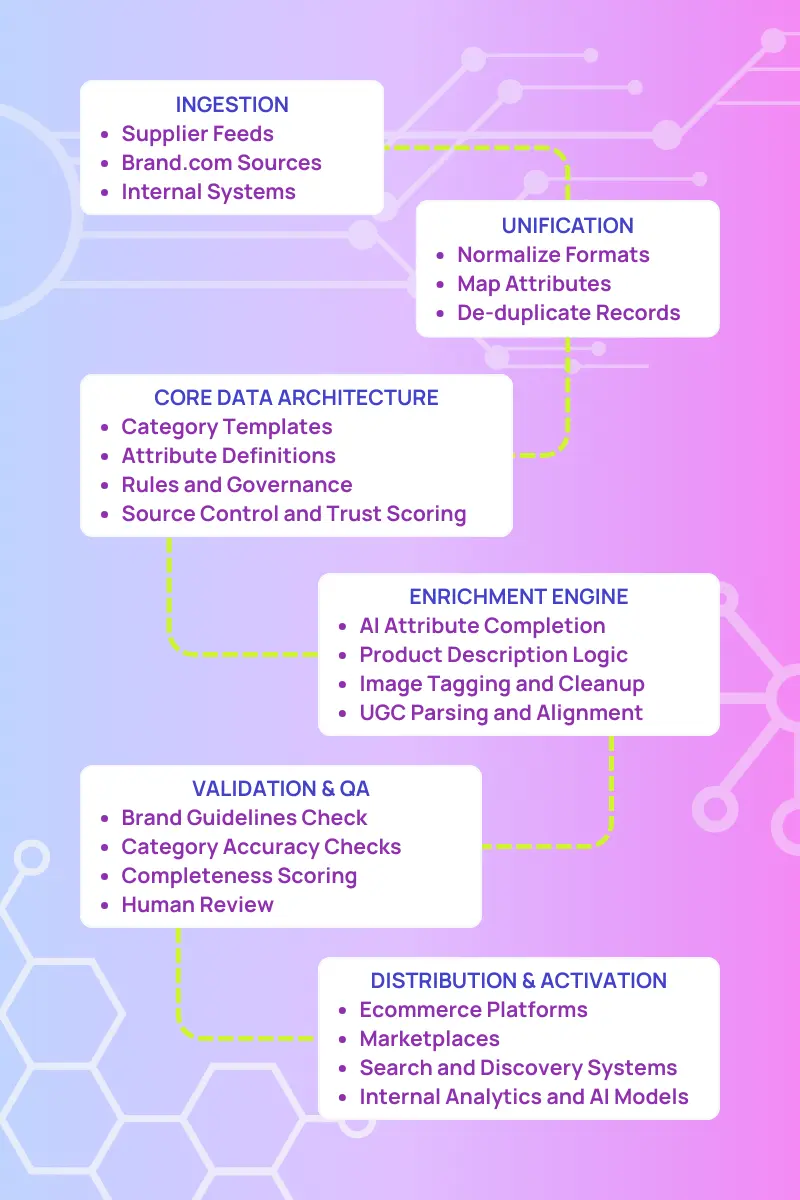
Here's one example of how that architecture can take shape at a retail organization and what's happening at each stage of the structure.
When architecture is weak, you see it everywhere.
This creates constant fire drills. Merchandising teams correct formatting. E-commerce teams rewrite descriptions. Developers create one off rules to patch the system together. Over time, this slows your catalog growth and reduces the quality of every digital customer experience.
Strong product data architecture feels simple because everything fits together.
Good architecture establishes a common language. It allows teams across digital, e-commerce, product, and marketing to work from the same foundation. It speeds up onboarding. It improves PDP performance. It reduces cleanup. It makes every future initiative easier.
Most importantly, good architecture pays long term dividends. Once your structure is in place, enrichment accelerates. Product updates move faster. Market expansion becomes easier. Your brand presents a consistent and complete experience everywhere customers shop.
As retailers lean deeper into automation, recommendation engines, predictive inventory planning, and agentic commerce, product data architecture becomes even more important. AI depends on clean structure. If your data foundation is weak, the tools you rely on cannot perform at their best.
Retailers that invest early in strong architecture will see:
This is how modern retail teams scale without sacrificing quality.
Trustana makes managing product data across systems and teams easy with an all-in-one, AI-powered product data management platform. Get your free demo today.
Product data architecture is the structure that organizes all product information across your business. It sets the rules, templates, and workflows that make product data clean, complete, and consistent. A strong architecture keeps your catalog accurate and ready for automation.
It reduces manual work, speeds up SKU onboarding, and ensures every team works from a single source of truth. Retailers with strong architecture launch products faster and deliver better PDPs, filtering, and search results.
AI tools perform best when the inputs are clean and structured. Good architecture provides consistent attributes, clear templates, and well defined rules. This helps AI generate better enrichment, more accurate tags, and higher quality product copy.
Enrichment becomes easier when the underlying architecture is strong. Clean templates, consistent attributes, and trusted sources allow enrichment tools to produce accurate, high quality content at scale.
Teams run into scattered files, inconsistent formats, missing details, and slow onboarding. AI systems struggle, enrichment becomes inconsistent, and catalogs grow slower than expected. Customer experience also suffers because PDPs lack the details shoppers need.
Look for signs like long onboarding times, heavy manual cleanup, missing attributes, inconsistent product copy, or poor SEO performance. If multiple teams maintain separate spreadsheets or custom rules, it is usually a sign that your current architecture is not supporting your goals.
Yes. The strongest architectures are designed to scale with new brands, new categories, and new channels. They evolve as business rules, marketplaces, and AI capabilities change.


