Introducing Context Graph: AI With Real Business Context
Context Graph enhances the application of your product rules, sources, and tone for better retail data governance and stronger product discoverability across every channel.
Published on
Most AI applications breaks the moment they hit real retail operations.
Not because the models aren't good enough – but because they don't understand how your business actually works.
Your sourcing hierarchy. Your naming conventions. Your compliance constraints. Your brand-level exceptions. Your category rules.
None of this is native to a general-purpose LLM.
So today, AI behaves like an untrained intern—sometimes brilliant, often chaotic, never predictable.
Today, all high-performing teams run on a shared context: rules, preferences, domain knowledge, tone, constraints, and institutional memory. This mix of formalized and unformalized factors help teams to make decisions that work best for their business environments.
In order for AI to perform at the highest levels, it needs the same thing.
Trustana’s Context Graph gives AI the institutional context it has been missing — so it can finally perform with the quality, consistency, and judgment your team expects.
What Goes Into Your Context Graph?
Context Graph is a governance layer for AI-generated product data.
It tells the AI exactly how your organization works:
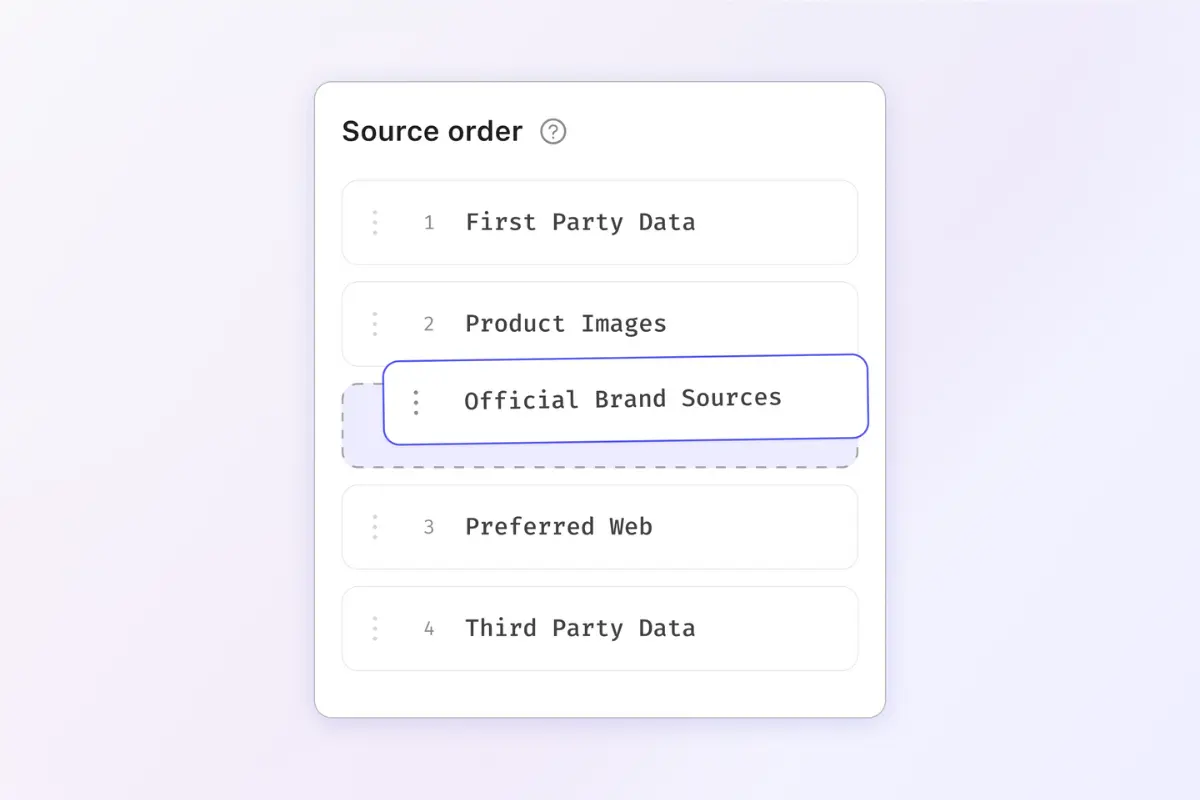
Where to search and what to prioritize in that search
What sources to trust and how to validate those sources
What vocabulary to use or avoid and what tone to follow
Where overrides apply and what "done right" means for your brand
What SEO signals matter for your categories
What business context drives decisions (seasonality, regional variations, etc.)
Context Graph converts your business rules and operational intelligence into a structured policy system—one the AI follows consistently at scale across your entire catalog, whether that’s ten thousands SKUs or millions.
And don’t worry – setup can be done once (and adjusted as your business context evolves), and our team of product data experts is at the ready to assist!
How Will Context Graph Improve My AI Output?
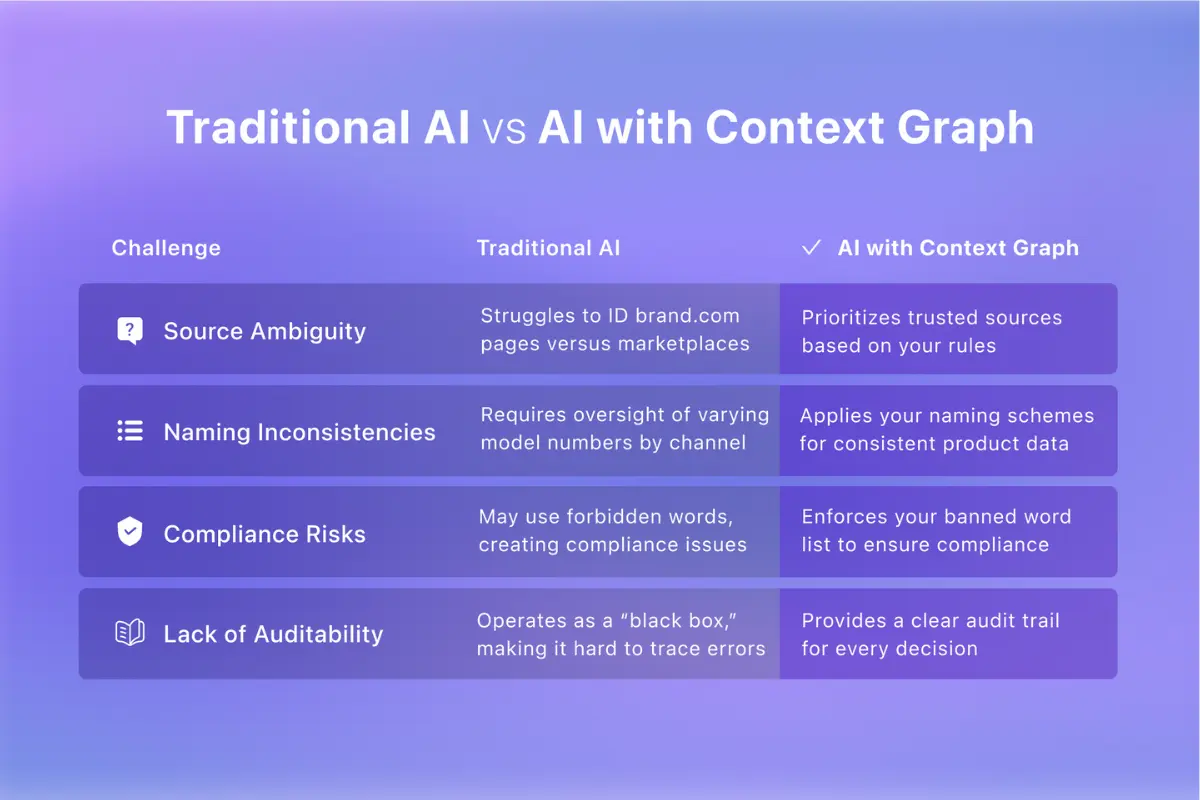
Compared to a generic AI, Trustana’s Context Graph enables superior accuracy and task-adherence, reducing manual corrections your team may need to make, and freeing up capacity for higher value tasks.
Context Graph can be applied in a wide range of ways to your business, including:
Applying a complex naming convention to all 100,000 products in your catalog
Ensuring that data for your products is ONLY sourced from brand.com
Following your company’s guidance in terms of “banned words” or “preferred phrases”
Prioritizing what data sourced from your suppliers should be prioritized, and what data can be ignored
...many more!
Ready To See It In Action?
Book a demo with Trustana and see how mid-market and enterprise retailers use Context Graph to deliver accurate, governed product data across every channel.
Today, all high-performing teams run on a shared context: rules, preferences, domain knowledge, tone, constraints, and institutional memory. This mix of formalized and unformalized factors help teams to make decisions that work best for their business environments.
In order for AI to perform at the highest levels, it needs the same thing.
Trustana’s Context Graph gives AI the institutional context it has been missing — so it can finally perform with the quality, consistency, and judgment your team expects.
What Goes Into Your Context Graph?
Context Graph is a governance layer for AI-generated product data.
It tells the AI exactly how your organization works:
Where to search and what to prioritize in that search
What sources to trust and how to validate those sources
What vocabulary to use or avoid and what tone to follow
Where overrides apply and what "done right" means for your brand
What SEO signals matter for your categories
What business context drives decisions (seasonality, regional variations, etc.)
Context Graph converts your business rules and operational intelligence into a structured policy system—one the AI follows consistently at scale across your entire catalog, whether that’s ten thousands SKUs or millions.
And don’t worry – setup can be done once (and adjusted as your business context evolves), and our team of product data experts is at the ready to assist!
How Will Context Graph Improve My AI Output?
Compared to a generic AI, Trustana’s Context Graph enables superior accuracy and task-adherence, reducing manual corrections your team may need to make, and freeing up capacity for higher value tasks.
Context Graph can be applied in a wide range of ways to your business, including:
Applying a complex naming convention to all 100,000 products in your catalog
Ensuring that data for your products is ONLY sourced from brand.com
Following your company’s guidance in terms of “banned words” or “preferred phrases”
Prioritizing what data sourced from your suppliers should be prioritized, and what data can be ignored
...many more!
Ready To See It In Action?
Book a demo with Trustana and see how mid-market and enterprise retailers use Context Graph to deliver accurate, governed product data across every channel.
Context Graph FAQ
Why can't I just use better prompts?
Prompts are instructions. Policies are contracts. At scale, you need precedence rules, version control, and audit trails—not longer prompts. Context Graph ensures your rules are enforced consistently across thousands of SKUs, not just suggested in a conversation.
How much setup does this require?
Most teams start with basic source and tone policies and refine from there. You don't need to map your entire operation on day one. Context Graph is designed to scale with you—start simple, add complexity as you need it.
What happens when policies conflict?
Context Graph uses a precedence model: Brand×Category overrides Brand, Brand overrides Category, Category overrides Account defaults. The system handles conflicts automatically based on specificity, so you always know which rule wins
Can I override the AI's decisions?
Always. Context Graph provides governance, not lock-in. Your team maintains full control to review, edit, or override any AI-generated content. The goal is to reduce manual work, not eliminate human judgment.
How is this different from a traditional PIM?
Instead of storing data and waiting for humans to update it, Trustana uses AI agents that work autonomously to enrich, validate, and optimize your product content at scale—all within governance rules you control.
Does this replace my existing PIM?
Trustana can work alongside your existing PIM or replace it entirely, depending on your needs. Many retailers use Trustana as their intelligence layer—governing how AI enriches data before it flows into legacy systems. Others replace their traditional PIM altogether, since Trustana handles both the repository and the enrichment natively. Either way, you get AI-powered automation without losing the governance and control you need.
How does this help with compliance and auditing?
Every attribute includes source-level provenance—you can trace exactly where information came from and which policies were applied. This makes audits straightforward and gives you defensible documentation for regulatory or legal review.
By clicking "Accept all cookies", you agree to storing cookies on your device to enhance site navigation, analyze site usage and assist in our marketing efforts as outlined in our privacy policy.
By clicking 'Accept all cookies', you agree to storing cookies on your device to enhance site navigation, analyze site usage and assist in our marketing efforts as outlined in our privacy policy.



.webp)


