
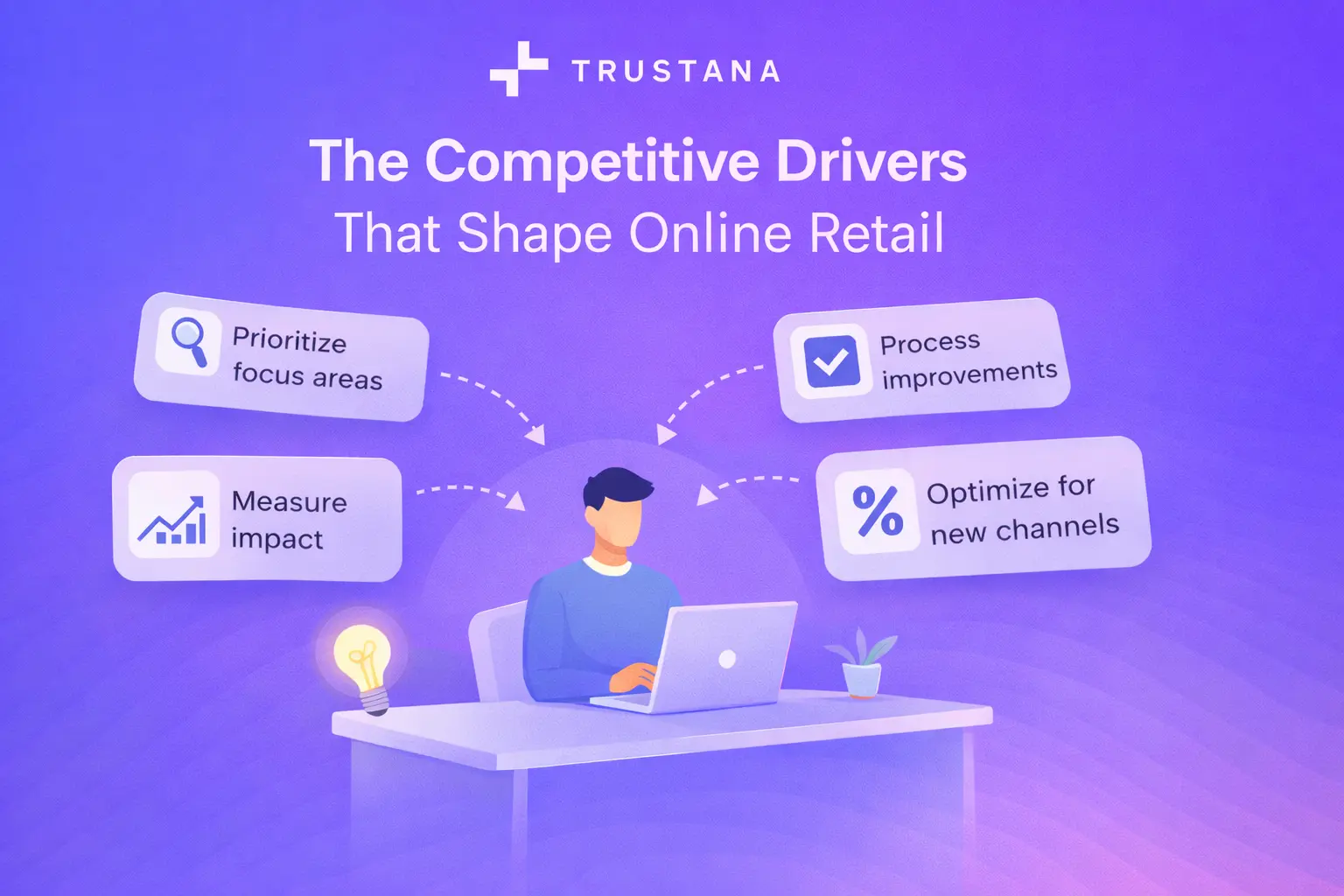
The Competitive Drivers That Shape Online Retail

Here's our take on the top 5 drivers of e-commerce performance, why they matter, what they impact, and how operators can put them to work.

This feature is available for customers on the

Tier or higher. Reach out to book a demo with our sales team today.

This feature is available for customers on the

Tier. Reach out to book a demo with our sales team today.

The Competitive Drivers That Shape Online Retail

On this page

If you spend any time working inside an online retail operation, you already know the truth: competition is tougher. Shoppers are more impatient. And the window to win a sale is shorter than ever.

Yet, the retailers who consistently outperform their peers share one thing in common. They focus their energy on the areas that matter most. Areas that shape the entire shopping journey. Areas that quietly decide who grows and who falls behind.

If you're looking for a bit of focus, some food for thought, or maybe just a good brainstorming exercize, have a look at our take on the top 5 drivers of e-commerce performance, why they matter, what they impact, and how operators can put them to work.

Driver 1: Better Product Detail Pages That Convert

Every online shopping journey is designed the product detail page. At least, it should be. This is the moment of truth. The place where shoppers decide: do I buy or do I walk away.

Strong product content is not about having more words. It is about clarity. Confidence. Helping someone feel sure about what they are about to buy. Position the benefits for the buyer first and foremost.

When content is vague or generic, people hesitate. They don't see what's in it for them. When details are missing, returns go up. And when every retailer uses the same supplier copy, nobody stands out. That's when price is your only real differentiator and it's a race to the bottom.

Real-world examples

  • Grocery: Clear nutrition and allergen clarity reduces friction and puts buyers at ease
  • Apparel: fit notes lower returns, especially when images show sizing on models
  • Sporting goods: specs guide beginners and confirm what experts are looking for
  • Industrial: clear technical details prevent errors, injuries, and non-compliance

How to Build PDPs that Convert

It's straightforward path to success here: clarify what each shopper needs to know. Build better templates. Strengthen imagery. Measure conversion, BTD, and returns.

Driver 2: A Faster, Smoother Shopping Experience

Speed is something shoppers feel before they realize it. Slow pages, confusing steps, long forms. They all create friction that quietly sends people elsewhere.

Live chat helps decision making in the moment. Certifications, badges, and UGC go a long way in telling shoppers "you're making the right call".

Real-world examples

  • Grocery: fast add-to-basket and repeatable orders = streamlined weekly shops
  • Apparel: shorter checkout = fewer abandoned carts
  • Sporting goods: fast comparison = confidence
  • Industrial: fast reorder flow and compatibility checkers = smoother operations

How to Streamline Online Shopping

Above all, your online experience needs to be fast and functional. Prioritize mobile first (this is where the bulk of online buying takes place) and focus on improving page load speeds. From there, simplify your checkout process. Make shipping and delivery info clear so expectations are set. Track abandonment and mobile conversion to see where further improvements can be made.

Driver 3: Products That Are Easy To Find

Discovery is more than SEO. It is the complete system that helps shoppers locate the right products and surfaces related products. Titles, attributes, filters, metadata, and internal search, all working together to connect the right shopper with the right product at the right time.

Localization is important. Make sure you are using the terms your shoppers use. If you sell across borders or operate in multiple regions, leverage the local lingo where you need to or you'll end up giving that business to a competitor.

When discovery breaks down, shoppers get lost and hit dead ends. That's when they leave.

Real-world examples

  • Grocery: accurate dietary attributes
  • Apparel: trend-based metadata
  • Sporting goods: specs tied to intended use
  • Industrial: exact part numbers and certifications

How to Make Products Easier to Find Online

Improve metadata. Expand attributes. Strengthen search relevance. Track search-to-cart rate and zero-result queries.

Driver 4: Personalization (That Feels Natural)

Personalization is the difference between warm and cold, but there's a limit. Take it too far and at best it gets annoying. Then it gets creepy. The best personalization feels human. It gently guides shoppers rather than shouting at them. When done well, it makes the journey faster and more relevant. When it's not, well, who here remembers Clippy?

Past purchase history is an easy marker to build personalization from, while segmentation can group together buyers with similar tastes and interests. Remmeber, the more focused your groups, the more relevant the suggestions.

These are rather elementary examples, and we bring them to the forefront because you are never going to outgrow them as a retailer. The biggest and best performaing brands cpontinually benefit from  focus on the fundamentals.

Real-world examples

  • Grocery: curate weekly staples
  • Apparel: style-based picks
  • Sporting goods: skill-level recommendations
  • Industrial: reorder suggestions

How to Personalize the Shopping Experience

Start with PDP-level recommendations. Tailor messages to behavior. Track RPV, repeat rate, and personalized CTR; these will guide how you build your audience segments for personalization.

Driver 5: Efficient Operations That Scale

Operational excellence is the engine behind every customer-facing win. Clean data. Fast onboarding. Clear governance. Less manual work. Healthy operations give teams room to grow.

Real-world examples

• Grocery: automated attributes speed brand onboarding
• Apparel: seasonal launches stay manageable
• Sporting goods: technical templates stay consistent
• Industrial: compliance becomes predictable

What to do next

Automate enrichment. Standardize categories. Add governance. Track time-to-market, hours saved, and return rate.

Next Steps

Ready to put your plans into action? reach out to sales and get a demo to see exactly how Trustana makes your business a success story when it comes to e-commerce performance.
Drivers of E-commerce Performance FAQ

How do I know which of the five drivers is holding my business back the most?
Start by mapping your funnel metrics to each driver. Low PDP conversion points to content issues. High bounce rates suggest experience problems. Poor search-to-cart signals discovery gaps. Weak repeat rates point to personalization. Slow launches indicate operational friction. The biggest leak usually reveals itself in the data.

Should I try to improve all five drivers at once?
No. Most high-performing retailers focus on one or two priority drivers per quarter. Trying to fix everything simultaneously usually leads to shallow progress. Sustainable growth comes from sequencing improvements, not piling them on.

What’s the most common mistake teams make after learning this framework?
Many teams over-invest in front-end features before fixing data and operations. Without clean, structured product data, improvements to personalization, discovery, and PDPs tend to underperform.

How much of ecommerce performance is driven by data quality versus UX design?
Both matter, but data quality is foundational. Poor data limits what design, search, and personalization systems can achieve. Strong UX amplifies good data, but it cannot compensate for missing or inconsistent information.

How do I align internal teams around these five drivers?
Use the drivers as shared performance pillars. Map each team’s responsibilities and KPIs to them. This creates a common language between merchandising, marketing, IT, and operations.

What should I prioritize if my catalog changes frequently?
High-change catalogs benefit most from operational automation and standardized templates. When products rotate quickly, manual workflows become the primary bottleneck to growth.

How do I balance speed of launch with content quality?
Top retailers automate baseline enrichment and reserve human review for high-impact products. This allows fast launches without sacrificing accuracy or brand consistency.

When does personalization stop delivering meaningful returns?
Personalization plateaus when segmentation becomes too broad or signals become noisy. At that point, improving data depth and behavioral accuracy usually produces better ROI than adding more recommendation rules.

How can I measure whether discovery improvements are actually working?
Beyond traffic and rankings, track zero-result searches, filter usage, search refinements, and search-to-cart rate. These indicators show whether shoppers are finding what they want efficiently.

What role does governance play in ecommerce performance?
Governance ensures that improvements persist. Without clear rules and ownership, data quality and content standards degrade over time, eroding gains across all five drivers.

How do leading retailers prevent “process debt” from building up?
They document workflows, automate repeatable tasks, and review operational metrics regularly. This prevents short-term fixes from becoming long-term liabilities.

Is it better to invest in new tools or improve existing systems first?
Most retailers see faster ROI from improving how they use current systems. New tools only create value when processes and data standards are already mature.

How do these drivers support AI adoption in retail?
AI systems depend on structured data, consistent content, and reliable workflows. Retailers who strengthen these drivers become AI-ready faster and see better results from automation and generative tools.

What changes when selling across multiple regions or channels?
Discovery, localization, and governance become more critical. Without centralized control, regional variations can fragment data quality and brand experience.

How do I justify investment in operations to non-technical leadership?
Link operational improvements directly to revenue outcomes: faster launches, lower returns, higher conversion, and reduced labor costs. Operations become a growth lever when framed in commercial terms.

Which driver typically delivers the fastest short-term gains?
PDP optimization and checkout simplification often produce the quickest wins. These changes directly affect conversion and can show impact within weeks.

Which driver creates the strongest long-term advantage?
Operational excellence. Over time, scalable systems and clean data compound, making every other improvement cheaper and faster to implement.

How mature should my organization be before focusing on advanced personalization?
Basic data hygiene, stable PDP templates, and reliable discovery should be in place first. Without these, advanced personalization rarely performs as expected.

How do I know when it’s time to move to the next level of optimization?
When improvements stop producing proportional gains, it usually signals a constraint elsewhere in the system. That’s your cue to shift focus to the next driver.

What does “world-class” ecommerce performance look like across these drivers?
It looks like fast launches, consistently high conversion, strong repeat behavior, minimal data cleanup, and continuous improvement driven by shared metrics.

How can this framework support long-term competitive advantage?
While competitors copy features, few invest deeply in systems and discipline. Mastering these five drivers creates structural advantages that are difficult to replicate.

Subscribe to our newsletter today

Lorem ipsum dolor sit amet consectetur nulla augue arcu pellentesque eget ut libero aliquet ut nibh.

Retrieval-Augmented Generation (RAG)
retrieval-augmented-generation-rag
Product Data Activation (PDA)
product-data-activation-pda
Product Data Architecture (PDA)
product-data-architecture-pda
Context Graph
context-graph
Buy to Detail Rate (BTD)
buy-to-detail-rate-btd
White Label Product
white-label-product
User Experience (UX)
user-experience-ux
UPC (Universal Product Code)
upc-universal-product-code
Third-Party Marketplace
third-party-marketplace
Syndication
syndication
Structured Data
structured-data
Sell-Through Rate
sell-through-rate
Stale Content
stale-content
Search Relevance
search-relevance
Search Merchandising
search-merchandising
SKU-Level Analytics
sku-level-analytics
SKU Rationalization
sku-rationalization
SKU Performance
sku-performance
SKU (Stock Keeping Unit)
sku-stock-keeping-unit
SEO (Search Engine Optimization)
seo-search-engine-optimization
Rich Media
rich-media
Retailer Portal
retailer-portal
Retail Media
retail-media
Retail Content Syndication
retail-content-syndication
Repricing Tool
repricing-tool
Retail Analytics
retail-analytics
Replatforming
replatforming
Real-Time Updates
real-time-updates
Quality Assurance (QA)
quality-assurance-qa
Product Visibility
product-visibility
Product Variant
product-variant
Product Validation
product-validation
Product Upload
product-upload
Product Title Optimization
product-title-optimization
Product Taxonomy Tree
product-taxonomy-tree
Product Taxonomy
product-taxonomy
Product Tagging
product-tagging
Product Syndication Lag
product-syndication-lag
Product Syndication
product-syndication
Product Schema
product-schema
Product Status Tracking
product-status-tracking
Product Page Bounce Rate
product-page-bounce-rate
Product Onboarding
product-onboarding
Product Metadata
product-metadata
Product Matching
product-matching
Product Lifecycle Stage
product-lifecycle-stage
Product Information Management (PIM)
product-information-management-pim
Product Lifecycle Management (PLM)
product-lifecycle-management-plm
Product Info Templates
product-info-templates
Product Import
product-import
Product Feed Validation
product-feed-validation
Product Feed Scheduling
product-feed-scheduling
Product Feed
product-feed
Product Family
product-family
Product Discovery
product-discovery
Product Export
product-export
Product Dimension Attributes
product-dimension-attributes
Product Detail Page (PDP)
product-detail-page-pdp
Product Description
product-description
Product Data Versioning
product-data-versioning
Product Data Syndication Platforms
product-data-syndication-platforms
Product Data Sheet
product-data-sheet
Product Data Quality
product-data-quality
Product Content Management (PCM)
product-content-management-pcm
Product Data Harmonization
product-data-harmonization
Product Content Enrichment
product-content-enrichment
Product Comparison
product-comparison
Product Compliance
product-compliance
Product Channel Fit
product-channel-fit
Product Categorization
product-categorization
Product Bundling
product-bundling
Product Badging
product-badging
Product Attributes
product-attributes
Product Attribute Completeness
product-attribute-completeness
Price Scraping
price-scraping
Personalization
personalization
PDP Optimization
pdp-optimization
PDP Heatmap
pdp-heatmap
PDP Conversion Rate
pdp-conversion-rate
Out-of-Stock Alerts
out-of-stock-alerts
Omnichannel
omnichannel
Omnichannel Strategy
omnichannel-strategy
Net New SKU Creation
net-new-sku-creation
Multichannel Retailing
multichannel-retailing
Metadata
metadata
Mobile Optimization
mobile-optimization
Merchant-to-Merchant (M2M)
merchant-to-merchant-m2m
Marketplace Listing Errors
marketplace-listing-errors
Marketplace Reconciliation
marketplace-reconciliation
Marketplace Compliance
marketplace-compliance
Marketplace
marketplace
MAP Pricing (Minimum Advertised Price)
map-pricing-minimum-advertised-price
Localization Tags
localization-tags
Long-Tail Keywords
long-tail-keywords
Listing Optimization
listing-optimization
Lifecycle Automation
lifecycle-automation
Key Performance Indicator (KPI)
key-performance-indicator-kpi
Inventory Management
inventory-management
Intelligent Search
intelligent-search
Image Optimization
image-optimization
Hyperpersonalization
hyperpersonalization
Headless Commerce
headless-commerce
Generative Engine Optimization (GEO)
generative-engine-optimization-geo
Generative AI
generative-ai
Fuzzy Search
fuzzy-search
GTM (Go-to-Market) Strategy
gtm-go-to-market-strategy
GTIN (Global Trade Item Number)
gtin-global-trade-item-number
Flat File
flat-file
First-Party Data
first-party-data-a51e9
First-Party Data
first-party-data
First-Mile Fulfillment
first-mile-fulfillment
Feed Testing Environment
feed-testing-environment
Feed-Based Advertising
feed-based-advertising
Feed Optimization Tool
feed-optimization-tool
Feed Management
feed-management
Feed Diagnostics
feed-diagnostics
Faceted Search
faceted-search
ERP (Enterprise Resource Planning)
erp-enterprise-resource-planning
Explainable AI
explainable-ai
Enrichment Rules
enrichment-rules
Enhanced Brand Content (EBC)
enhanced-brand-content-ebc
EPID (eBay Product ID)
epid-ebay-product-id
EAN (European Article Number)
ean-european-article-number
E-commerce Platform
e-commerce-platform
Dynamic Pricing
dynamic-pricing
Duplicate Content
duplicate-content
Direct-to-Consumer (DTC)
direct-to-consumer-dtc
Drop Shipping
drop-shipping
Digital Transformation
digital-transformation
Digital Shelf
digital-shelf
Digital Asset Management (DAM)
digital-asset-management-dam
Data Syncing
data-syncing
Data Normalization
data-normalization
Data Mapping
data-mapping
Data Governance
data-governance
Data Feed Transformation
data-feed-transformation
Data Feed Rules
data-feed-rules
Data Feed Error Report
data-feed-error-report
Data Enrichment Pipeline
data-enrichment-pipeline
Data Drift
data-drift
Data Deduplication
data-deduplication
Data Clean-up
data-clean-up
Customer Experience (CX)
customer-experience-cx
Conversion Rate
conversion-rate
Content Scalability
content-scalability
Content Localization
content-localization
Content Governance
content-governance
Content Gaps
content-gaps
Consumer-to-Merchant (C2M)
consumer-to-merchant-c2m
Channel-Specific Optimization
channel-specific-optimization
Channel Readiness
channel-readiness
Category Mapping
category-mapping
Catalog Management
catalog-management
Buy Now, Pay Later (BNPL)
buy-now-pay-later-bnpl
Breadcrumb Navigation
breadcrumb-navigation
Automated Categorization
automated-categorization
Automated Content Generation
automated-content-generation
Automated Workflows
automated-workflows
Blacklisting (in feeds)
blacklisting-in-feeds
Attribution Tags
attribution-tags
Attribute Standardization
attribute-standardization
Answer Engine Optimization (AEO)
answer-engine-optimization-aeo
Artificial Intelligence (AI)
artificial-intelligence-ai
Attribute Mapping
attribute-mapping
Agentic E-commerce
agentic-e-commerce
A/B Testing
a-b-testing
API (Application Programming Interface)
api-application-programming-interface
AI Overviews
ai-overviews
AI Tagging
ai-tagging
AI Agents
ai-agents
AI Indexing
ai-indexing