
December 15, 2025

Data Source Control: Cleaner, More Trustworthy Product Data at Scale

If clean product data is the foundation of digital commerce, Data Source Control is the quiet superpower that keeps that foundation solid while the rest of your business moves forward at full speed.

This feature is available for customers on the

Professional

Tier or higher. Reach out to book a demo with our sales team today.

This feature is available for customers on the

Professional

Tier. Reach out to book a demo with our sales team today.

Data Source Control: Cleaner, More Trustworthy Product Data at Scale

On this page

Product data should feel simple. A shopper clicks on something, sees the details they need, and makes a confident choice. But behind the scenes, retailers know the truth: data comes from everywhere, in every format, and with every level of accuracy. One brand calls it “color,” another calls it “shade.” One supplier gives you full details, another gives you two lines of text. If you want that data to stay clean, consistent, and ready for AI, you usually trade speed for control.

Data Source Control changes that equation.

What Data Source Control Is

Data Source Control is the intelligence layer that tells your enrichment engine where to look when pulling product information.

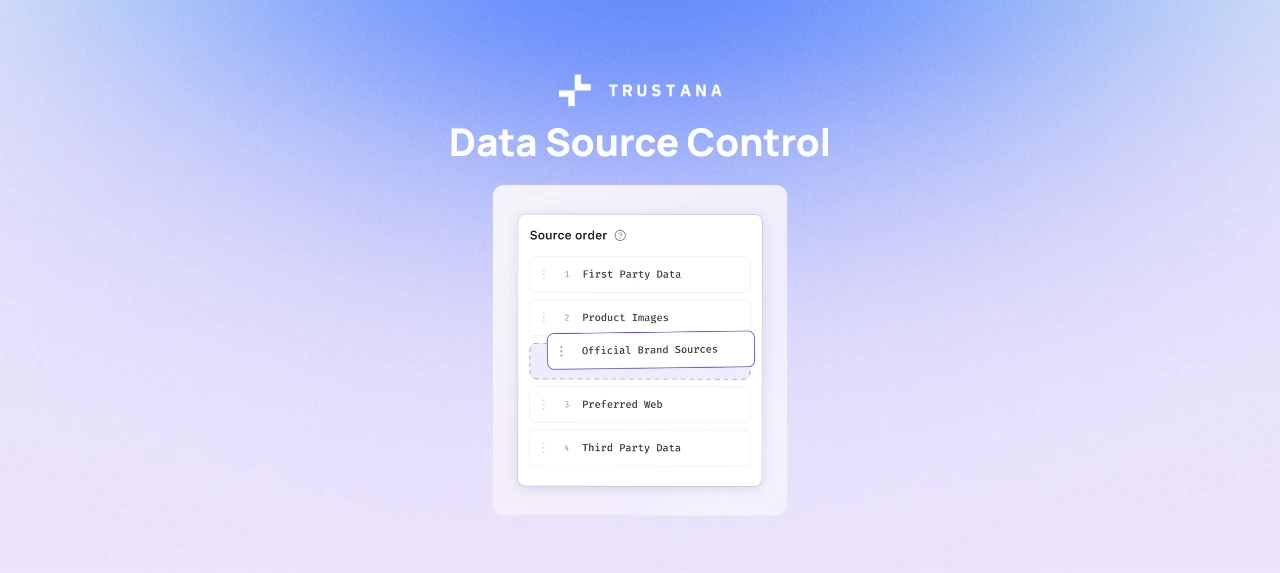
Instead of letting an AI model decide on its own, letting it roam free to search across the open web, supplier feeds, or whatever data happens to be available, Data Source Control allows you to define exactly which sources are trustworthy.

It is the mechanism(s) by which retailers can set rules for product category, by brand, or both. This means prioritizing brand-owned domains, so the system always chooses the most authoritative source first, and establishing a trusted domain list that prevents unreliable or inconsistent sources from ever influencing product data.

Why It Matters for Retailers

For retailers, the value is straightforward. When your data comes from everywhere, your teams waste countless hours cleaning, correcting, and reconciling inconsistencies before those products ever make it online.

Data Source Control removes that uncertainty by guiding AI according to your business logic. The model knows from where to pull information, how to rank sources, and what to ignore entirely. You get cleaner product data, fewer manual fixes, faster SKU onboarding, and a catalog that stays consistent as it evolves.

This is how you get confidence in your data without slowing down your digital operations. No more enrichment runs pulling questionable details from random websites. No more manual cleanup to fix small-but-important errors that slip through. Data Source Control keeps the model focused on what's important to your business by letting you specify trusted domains, category-level rules, and brand-first logic t every output reflects how your business actually works.

With the right guardrails, enrichment becomes a predictable, repeatable system you can trust.

Think of it as the best parts of LLMs with none of the junk that clogs up your systems and slows your teams.

How Trustana Provides Data Source Control

With Trustana’s recent release of Context Graph, retailers finally have a way to guide AI the same way they guide their teams. Instead of letting a general LLM wander through the internet and guess which information is correct, Data Source Control sets clear boundaries.

You choose which sources matter most.

You decide whether brand.com is the single source of truth.

You define how each category or brand should be handled. And the system follows those rules automatically, at scale.

If clean product data is the foundation of digital commerce, Data Source Control is the quiet superpower that keeps that foundation solid while the rest of your business moves at full speed.

Book a demo with Trustana and see how mid-market and enterprise retailers use our new Context Graph functionality to deliver accurate, governed product data across every channel.
Data Source Control FAQ

What is Data Source Control?

Data Source Control is a new capability within Trustana that lets retailers decide which data sources are trusted when enriching or extracting product information. It gives teams more accuracy and authority when it comes to designating from which sources product data should be derived.

Why does source control matter for product data?

Most product data comes from many different feeds, suppliers, and websites. Without direction, AI models can mix good sources with unreliable ones. Source control keeps enrichment aligned with your business rules so the output stays clean and consistent.

How does Data Source Control improve AI accuracy?

It provides the guardrails AI needs. By setting category-level or brand-level sourcing rules and prioritizing brand-owned domains, retailers ensure the model pulls data from reliable places — minimizing errors and reducing manual cleanup.

Will this slow down my workflow?

No. Once rules are set, the system applies them automatically across large catalogs.

What if my brand or supplier formats data differently?

You can define rules by brand or product category, so no matter how sources differ, the enrichment process stays structured and predictable.

How does this help teams working at scale?

By removing uncertainty. Instead of your team reviewing every output for inconsistencies, Data Source Control ensures the AI model stays aligned from the start, allowing thousands of SKUs to be enriched faster with fewer corrections.

Is this only useful for AI-driven enrichment?

It’s especially powerful for AI use cases, but the benefits extend across search, navigation, SEO, PDP quality, and any workflow that depends on clean product data.

Get an Expert Review of Your Product Data

Get practical guidance on improving catalog quality, enrichment workflows, and AI readiness based on your current setup.

dynamic synthesis
dynamic-synthesis
operational layer
operational-layer
Evidence Layer
evidence-layer
Probabilistic Accuracy
probabilistic-accuracy
Deterministic accuracy
deterministic-accuracy
Product Attribute
product-attribute
Intelligent Product Attribute
intelligent-product-attribute
Factual Product Attribute
factual-product-attribute
Structured Product Attribute
structured-product-attribute
Google MCP (Model Context Protocol)
google-mcp-model-context-protocol
Retrieval-Augmented Generation (RAG)
retrieval-augmented-generation-rag
Product Data Activation (PDA)
product-data-activation-pda
Product Data Architecture (PDA)
product-data-architecture-pda
Context Graph
context-graph
Buy to Detail Rate (BTD)
buy-to-detail-rate-btd
White Label Product
white-label-product
User Experience (UX)
user-experience-ux
UPC (Universal Product Code)
upc-universal-product-code
Third-Party Marketplace
third-party-marketplace
Syndication
syndication
Structured Data
structured-data
Sell-Through Rate
sell-through-rate
Stale Content
stale-content
Search Relevance
search-relevance
Search Merchandising
search-merchandising
SKU-Level Analytics
sku-level-analytics
SKU Rationalization
sku-rationalization
SKU Performance
sku-performance
SKU (Stock Keeping Unit)
sku-stock-keeping-unit
SEO (Search Engine Optimization)
seo-search-engine-optimization
Rich Media
rich-media
Retailer Portal
retailer-portal
Retail Media
retail-media
Retail Content Syndication
retail-content-syndication
Repricing Tool
repricing-tool
Retail Analytics
retail-analytics
Replatforming
replatforming
Real-Time Updates
real-time-updates
Quality Assurance (QA)
quality-assurance-qa
Product Visibility
product-visibility
Product Variant
product-variant
Product Validation
product-validation
Product Upload
product-upload
Product Title Optimization
product-title-optimization
Product Taxonomy Tree
product-taxonomy-tree
Product Taxonomy
product-taxonomy
Product Tagging
product-tagging
Product Syndication Lag
product-syndication-lag
Product Syndication
product-syndication
Product Schema
product-schema
Product Status Tracking
product-status-tracking
Product Page Bounce Rate
product-page-bounce-rate
Product Onboarding
product-onboarding
Product Metadata
product-metadata
Product Matching
product-matching
Product Lifecycle Stage
product-lifecycle-stage
Product Information Management (PIM)
product-information-management-pim
Product Lifecycle Management (PLM)
product-lifecycle-management-plm
Product Info Templates
product-info-templates
Product Import
product-import
Product Feed Validation
product-feed-validation
Product Feed Scheduling
product-feed-scheduling
Product Feed
product-feed
Product Family
product-family
Product Discovery
product-discovery
Product Export
product-export
Product Dimension Attributes
product-dimension-attributes
Product Detail Page (PDP)
product-detail-page-pdp
Product Description
product-description
Product Data Versioning
product-data-versioning
Product Data Syndication Platforms
product-data-syndication-platforms
Product Data Sheet
product-data-sheet
Product Data Quality
product-data-quality
Product Content Management (PCM)
product-content-management-pcm
Product Data Harmonization
product-data-harmonization
Product Content Enrichment
product-content-enrichment
Product Comparison
product-comparison
Product Compliance
product-compliance
Product Channel Fit
product-channel-fit
Product Categorization
product-categorization
Product Bundling
product-bundling
Product Badging
product-badging
Product Attributes
product-attributes
Product Attribute Completeness
product-attribute-completeness
Price Scraping
price-scraping
Personalization
personalization
PDP Optimization
pdp-optimization
PDP Heatmap
pdp-heatmap
PDP Conversion Rate
pdp-conversion-rate
Out-of-Stock Alerts
out-of-stock-alerts
Omnichannel
omnichannel
Omnichannel Strategy
omnichannel-strategy
Net New SKU Creation
net-new-sku-creation
Multichannel Retailing
multichannel-retailing
Metadata
metadata
Mobile Optimization
mobile-optimization
Merchant-to-Merchant (M2M)
merchant-to-merchant-m2m
Marketplace Listing Errors
marketplace-listing-errors
Marketplace Reconciliation
marketplace-reconciliation
Marketplace Compliance
marketplace-compliance
Marketplace
marketplace
MAP Pricing (Minimum Advertised Price)
map-pricing-minimum-advertised-price
Localization Tags
localization-tags
Long-Tail Keywords
long-tail-keywords
Listing Optimization
listing-optimization
Lifecycle Automation
lifecycle-automation
Key Performance Indicator (KPI)
key-performance-indicator-kpi
Inventory Management
inventory-management
Intelligent Search
intelligent-search
Image Optimization
image-optimization
Hyperpersonalization
hyperpersonalization
Headless Commerce
headless-commerce
Generative Engine Optimization (GEO)
generative-engine-optimization-geo
Generative AI
generative-ai
Fuzzy Search
fuzzy-search
GTM (Go-to-Market) Strategy
gtm-go-to-market-strategy
GTIN (Global Trade Item Number)
gtin-global-trade-item-number
Flat File
flat-file
First-Party Data
first-party-data-a51e9
First-Party Data
first-party-data
First-Mile Fulfillment
first-mile-fulfillment
Feed Testing Environment
feed-testing-environment
Feed-Based Advertising
feed-based-advertising
Feed Optimization Tool
feed-optimization-tool
Feed Management
feed-management
Feed Diagnostics
feed-diagnostics
Faceted Search
faceted-search
ERP (Enterprise Resource Planning)
erp-enterprise-resource-planning
Explainable AI
explainable-ai
Enrichment Rules
enrichment-rules
Enhanced Brand Content (EBC)
enhanced-brand-content-ebc
EPID (eBay Product ID)
epid-ebay-product-id
EAN (European Article Number)
ean-european-article-number
E-commerce Platform
e-commerce-platform
Dynamic Pricing
dynamic-pricing
Duplicate Content
duplicate-content
Direct-to-Consumer (DTC)
direct-to-consumer-dtc
Drop Shipping
drop-shipping
Digital Transformation
digital-transformation
Digital Shelf
digital-shelf
Digital Asset Management (DAM)
digital-asset-management-dam
Data Syncing
data-syncing
Data Normalization
data-normalization
Data Mapping
data-mapping
Data Governance
data-governance
Data Feed Transformation
data-feed-transformation
Data Feed Rules
data-feed-rules
Data Feed Error Report
data-feed-error-report
Data Enrichment Pipeline
data-enrichment-pipeline
Data Drift
data-drift
Data Deduplication
data-deduplication
Data Clean-up
data-clean-up
Customer Experience (CX)
customer-experience-cx
Conversion Rate
conversion-rate
Content Scalability
content-scalability
Content Localization
content-localization
Content Governance
content-governance
Content Gaps
content-gaps
Consumer-to-Merchant (C2M)
consumer-to-merchant-c2m
Channel-Specific Optimization
channel-specific-optimization
Channel Readiness
channel-readiness
Category Mapping
category-mapping
Catalog Management
catalog-management
Buy Now, Pay Later (BNPL)
buy-now-pay-later-bnpl
Breadcrumb Navigation
breadcrumb-navigation
Automated Categorization
automated-categorization
Automated Content Generation
automated-content-generation
Automated Workflows
automated-workflows
Blacklisting (in feeds)
blacklisting-in-feeds
Attribution Tags
attribution-tags
Attribute Standardization
attribute-standardization
Answer Engine Optimization (AEO)
answer-engine-optimization-aeo
Artificial Intelligence (AI)
artificial-intelligence-ai
Attribute Mapping
attribute-mapping
Agentic E-commerce
agentic-e-commerce
A/B Testing
a-b-testing
API (Application Programming Interface)
api-application-programming-interface
AI Overviews
ai-overviews
AI Tagging
ai-tagging
AI Agents
ai-agents
AI Indexing
ai-indexing