September 24, 2025

New Upgrades to Trustana's AI Attributes: data sources, output formats, and content rules

We’re thrilled to announce exciting upgrades to our AI Attributes—the building blocks of Trustana’s product data platform.

This feature is available for customers on the

Tier or higher. Reach out to book a demo with our sales team today.

This feature is available for customers on the

Tier. Reach out to book a demo with our sales team today.

New Upgrades to Trustana's AI Attributes: data sources, output formats, and content rules

On this page

We’re thrilled to announce exciting upgrades to our AI Attributes—the building blocks of Trustana’s product data platform.

What Are AI Attributes?

For those new to Trustana, what makes AI Attributes stand out is their flexibility—you can adapt them across industries and use cases, whether it’s generating SEO-friendly tags for fashion, crafting localized product descriptions for food and beverages, or setting precise specifications for electronics. They’re like building blocks you can reuse anywhere, designed to fit your unique needs seamlessly.
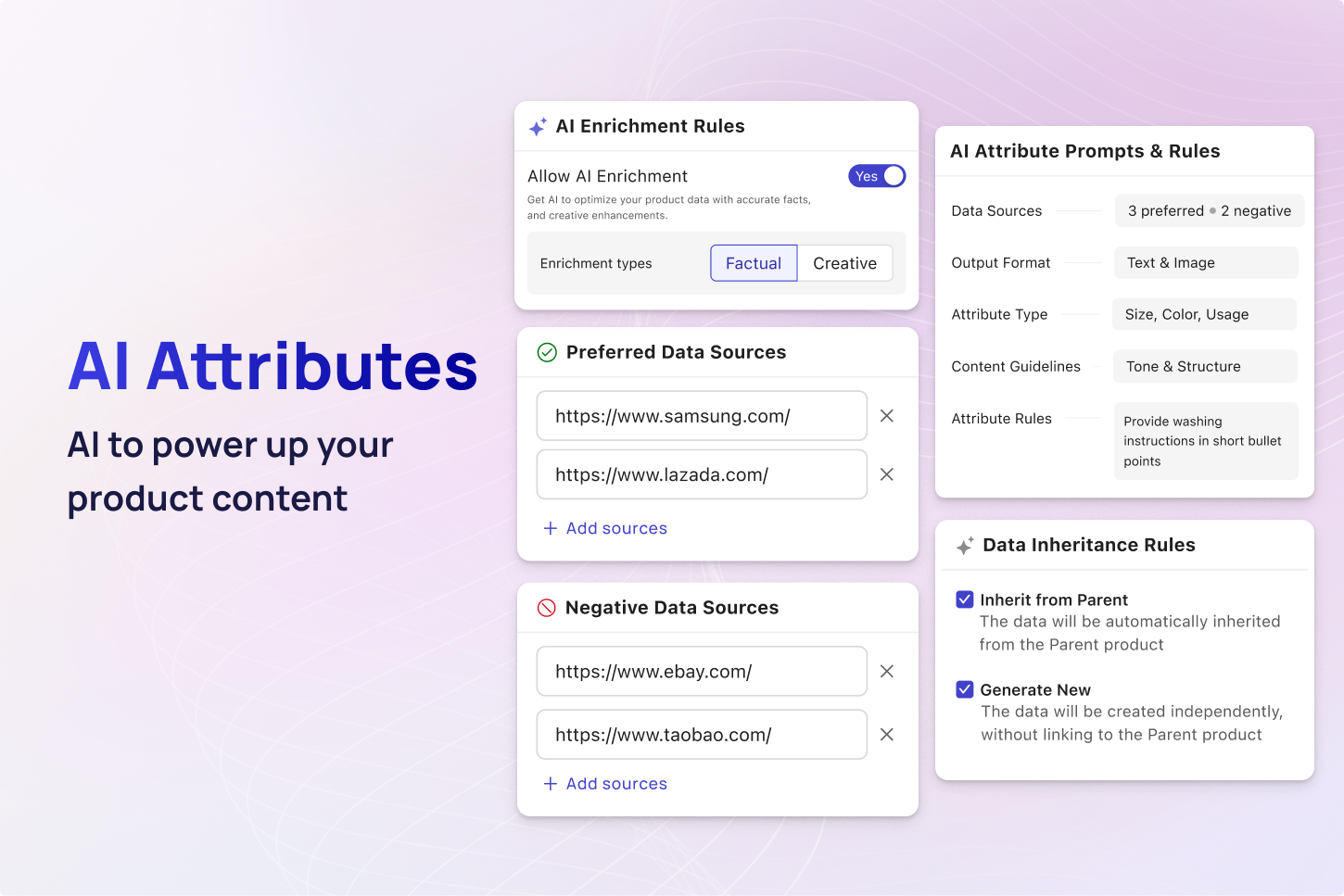
AI Attribute upgrades, designed to give you more control over data sources, output formats, and content rules

What’s New?

We’ve made AI Attributes smarter, more flexible, and easier to control. Here’s what you can now do:

  • Pick and prioritize the data sources that matter most to you—flagging the ones you trust while avoiding irrelevant inputs.
  • Choose how your content is displayed, from rich text and tables to size charts and other formats. 
  • Define details that truly matter, like Size, Color, or Usage, so your attributes align with what your customers care about.
  • Adjust the tone, style, and structure of your content to keep everything on-brand.
  • Set specific rules for each attribute, making sure your product data meets your unique needs every time.

AI Attribute upgrades, designed to give you more control over data sources, output formats, and content rules

How You Can Use It

Say you’re launching eco-friendly products. With Trustana's AI Attributes, you can:

  • Prioritize trusted sustainability certifications as your main data source.
  • Write product descriptions in a warm, approachable tone.
  • Add unique attributes like "Materials" or "Eco Rating" to highlight what makes your products special.
  • Enforce rules to ensure all images meet your quality standards.
  • Generate a customer-centered FAQ to show how your content differentiates and builds trust with your audience.
  • Create product comparisons to highlight key advantages of your products over competitors.

Why Does This Matter?

These upgrades put you firmly in control. You decide how data is sourced, formatted, and enriched, giving you the flexibility to build a content strategy that works for your business. Whether you’re managing a massive catalog or tuning details for a niche product, AI Attributes ensure your data works for you—not the other way around.

Request a demo today and get started building better product content that earns you more sales.
AI Attributes, Data Sources, Output Formats & Content Rules FAQ

What are AI Attributes in Trustana’s product data platform?
AI Attributes are configurable building blocks that allow you to define how product information is structured, enriched, formatted, and governed across your catalog. They can handle text, numeric values, lists, tables, and other output formats while adapting to specific business needs.

Why are data sources important for AI Attributes?
Data sources determine where the input information comes from before AI enrichment. By prioritizing trusted internal or external sources and flagging or excluding low-quality sources, you improve the quality and accuracy of the output.

What kinds of data sources can be used with Trustana’s AI Attributes?
AI Attributes can pull from multiple inputs such as ERP systems, supplier feeds, product specs, CSV uploads, images, and trusted public data. You can prioritize those that matter most to your business and block sources that don’t meet quality standards.

How do output formats work with AI Attributes?
Output formats control how enriched content appears. You can choose rich text, tables, size charts, lists, JSON-ready data structures, or other formats that match your publishing needs, improving clarity for internal teams and external platforms.

Can Trustana AI Attributes help with brand-consistent content?
Yes. You can set rules around tone, style, structure, and formatting so that automated content reflects your brand voice and messaging guidelines across all product descriptions and attribute outputs.

What are content rules and how do they improve product data?
Content rules let you enforce guidelines for how attributes are generated and validated. For example, you can require certain attributes to always be present, restrict formats for specific channels, or enforce quality standards before publication.

How do AI Attributes support multi-channel publishing?
By configuring data sources and output formats with built-in rules, AI Attributes generate content that aligns with each channel’s requirements, ensuring consistent listings on ecommerce platforms, marketplaces, and internal search engines.

Can AI Attributes reduce manual product content work?
Yes. By automating enrichment, formatting, and governance according to your defined rules, teams spend far less time manually filling gaps, correcting errors, or reformatting product information for different use cases.

How do these attribute upgrades benefit large catalogs and enterprise teams?
Upgraded AI Attributes provide control, consistency, and scalability—letting teams manage thousands of SKUs with governance, source prioritization, and output rules that maintain quality and compliance across product lines.

Do these features integrate with other Trustana AI tools?
Yes. AI Attributes work within Trustana’s broader AI enrichment and content automation suite, connecting to image enrichment, dynamic attribute enrichment, and downstream workflows like syndication and publishing.

Get an Expert Review of Your Product Data

Get practical guidance on improving catalog quality, enrichment workflows, and AI readiness based on your current setup.

dynamic synthesis
dynamic-synthesis
operational layer
operational-layer
Evidence Layer
evidence-layer
Probabilistic Accuracy
probabilistic-accuracy
Deterministic accuracy
deterministic-accuracy
Product Attribute
product-attribute
Intelligent Product Attribute
intelligent-product-attribute
Factual Product Attribute
factual-product-attribute
Structured Product Attribute
structured-product-attribute
Google MCP (Model Context Protocol)
google-mcp-model-context-protocol
Retrieval-Augmented Generation (RAG)
retrieval-augmented-generation-rag
Product Data Activation (PDA)
product-data-activation-pda
Product Data Architecture (PDA)
product-data-architecture-pda
Context Graph
context-graph
Buy to Detail Rate (BTD)
buy-to-detail-rate-btd
White Label Product
white-label-product
User Experience (UX)
user-experience-ux
UPC (Universal Product Code)
upc-universal-product-code
Third-Party Marketplace
third-party-marketplace
Syndication
syndication
Structured Data
structured-data
Sell-Through Rate
sell-through-rate
Stale Content
stale-content
Search Relevance
search-relevance
Search Merchandising
search-merchandising
SKU-Level Analytics
sku-level-analytics
SKU Rationalization
sku-rationalization
SKU Performance
sku-performance
SKU (Stock Keeping Unit)
sku-stock-keeping-unit
SEO (Search Engine Optimization)
seo-search-engine-optimization
Rich Media
rich-media
Retailer Portal
retailer-portal
Retail Media
retail-media
Retail Content Syndication
retail-content-syndication
Repricing Tool
repricing-tool
Retail Analytics
retail-analytics
Replatforming
replatforming
Real-Time Updates
real-time-updates
Quality Assurance (QA)
quality-assurance-qa
Product Visibility
product-visibility
Product Variant
product-variant
Product Validation
product-validation
Product Upload
product-upload
Product Title Optimization
product-title-optimization
Product Taxonomy Tree
product-taxonomy-tree
Product Taxonomy
product-taxonomy
Product Tagging
product-tagging
Product Syndication Lag
product-syndication-lag
Product Syndication
product-syndication
Product Schema
product-schema
Product Status Tracking
product-status-tracking
Product Page Bounce Rate
product-page-bounce-rate
Product Onboarding
product-onboarding
Product Metadata
product-metadata
Product Matching
product-matching
Product Lifecycle Stage
product-lifecycle-stage
Product Information Management (PIM)
product-information-management-pim
Product Lifecycle Management (PLM)
product-lifecycle-management-plm
Product Info Templates
product-info-templates
Product Import
product-import
Product Feed Validation
product-feed-validation
Product Feed Scheduling
product-feed-scheduling
Product Feed
product-feed
Product Family
product-family
Product Discovery
product-discovery
Product Export
product-export
Product Dimension Attributes
product-dimension-attributes
Product Detail Page (PDP)
product-detail-page-pdp
Product Description
product-description
Product Data Versioning
product-data-versioning
Product Data Syndication Platforms
product-data-syndication-platforms
Product Data Sheet
product-data-sheet
Product Data Quality
product-data-quality
Product Content Management (PCM)
product-content-management-pcm
Product Data Harmonization
product-data-harmonization
Product Content Enrichment
product-content-enrichment
Product Comparison
product-comparison
Product Compliance
product-compliance
Product Channel Fit
product-channel-fit
Product Categorization
product-categorization
Product Bundling
product-bundling
Product Badging
product-badging
Product Attributes
product-attributes
Product Attribute Completeness
product-attribute-completeness
Price Scraping
price-scraping
Personalization
personalization
PDP Optimization
pdp-optimization
PDP Heatmap
pdp-heatmap
PDP Conversion Rate
pdp-conversion-rate
Out-of-Stock Alerts
out-of-stock-alerts
Omnichannel
omnichannel
Omnichannel Strategy
omnichannel-strategy
Net New SKU Creation
net-new-sku-creation
Multichannel Retailing
multichannel-retailing
Metadata
metadata
Mobile Optimization
mobile-optimization
Merchant-to-Merchant (M2M)
merchant-to-merchant-m2m
Marketplace Listing Errors
marketplace-listing-errors
Marketplace Reconciliation
marketplace-reconciliation
Marketplace Compliance
marketplace-compliance
Marketplace
marketplace
MAP Pricing (Minimum Advertised Price)
map-pricing-minimum-advertised-price
Localization Tags
localization-tags
Long-Tail Keywords
long-tail-keywords
Listing Optimization
listing-optimization
Lifecycle Automation
lifecycle-automation
Key Performance Indicator (KPI)
key-performance-indicator-kpi
Inventory Management
inventory-management
Intelligent Search
intelligent-search
Image Optimization
image-optimization
Hyperpersonalization
hyperpersonalization
Headless Commerce
headless-commerce
Generative Engine Optimization (GEO)
generative-engine-optimization-geo
Generative AI
generative-ai
Fuzzy Search
fuzzy-search
GTM (Go-to-Market) Strategy
gtm-go-to-market-strategy
GTIN (Global Trade Item Number)
gtin-global-trade-item-number
Flat File
flat-file
First-Party Data
first-party-data-a51e9
First-Party Data
first-party-data
First-Mile Fulfillment
first-mile-fulfillment
Feed Testing Environment
feed-testing-environment
Feed-Based Advertising
feed-based-advertising
Feed Optimization Tool
feed-optimization-tool
Feed Management
feed-management
Feed Diagnostics
feed-diagnostics
Faceted Search
faceted-search
ERP (Enterprise Resource Planning)
erp-enterprise-resource-planning
Explainable AI
explainable-ai
Enrichment Rules
enrichment-rules
Enhanced Brand Content (EBC)
enhanced-brand-content-ebc
EPID (eBay Product ID)
epid-ebay-product-id
EAN (European Article Number)
ean-european-article-number
E-commerce Platform
e-commerce-platform
Dynamic Pricing
dynamic-pricing
Duplicate Content
duplicate-content
Direct-to-Consumer (DTC)
direct-to-consumer-dtc
Drop Shipping
drop-shipping
Digital Transformation
digital-transformation
Digital Shelf
digital-shelf
Digital Asset Management (DAM)
digital-asset-management-dam
Data Syncing
data-syncing
Data Normalization
data-normalization
Data Mapping
data-mapping
Data Governance
data-governance
Data Feed Transformation
data-feed-transformation
Data Feed Rules
data-feed-rules
Data Feed Error Report
data-feed-error-report
Data Enrichment Pipeline
data-enrichment-pipeline
Data Drift
data-drift
Data Deduplication
data-deduplication
Data Clean-up
data-clean-up
Customer Experience (CX)
customer-experience-cx
Conversion Rate
conversion-rate
Content Scalability
content-scalability
Content Localization
content-localization
Content Governance
content-governance
Content Gaps
content-gaps
Consumer-to-Merchant (C2M)
consumer-to-merchant-c2m
Channel-Specific Optimization
channel-specific-optimization
Channel Readiness
channel-readiness
Category Mapping
category-mapping
Catalog Management
catalog-management
Buy Now, Pay Later (BNPL)
buy-now-pay-later-bnpl
Breadcrumb Navigation
breadcrumb-navigation
Automated Categorization
automated-categorization
Automated Content Generation
automated-content-generation
Automated Workflows
automated-workflows
Blacklisting (in feeds)
blacklisting-in-feeds
Attribution Tags
attribution-tags
Attribute Standardization
attribute-standardization
Answer Engine Optimization (AEO)
answer-engine-optimization-aeo
Artificial Intelligence (AI)
artificial-intelligence-ai
Attribute Mapping
attribute-mapping
Agentic E-commerce
agentic-e-commerce
A/B Testing
a-b-testing
API (Application Programming Interface)
api-application-programming-interface
AI Overviews
ai-overviews
AI Tagging
ai-tagging
AI Agents
ai-agents
AI Indexing
ai-indexing